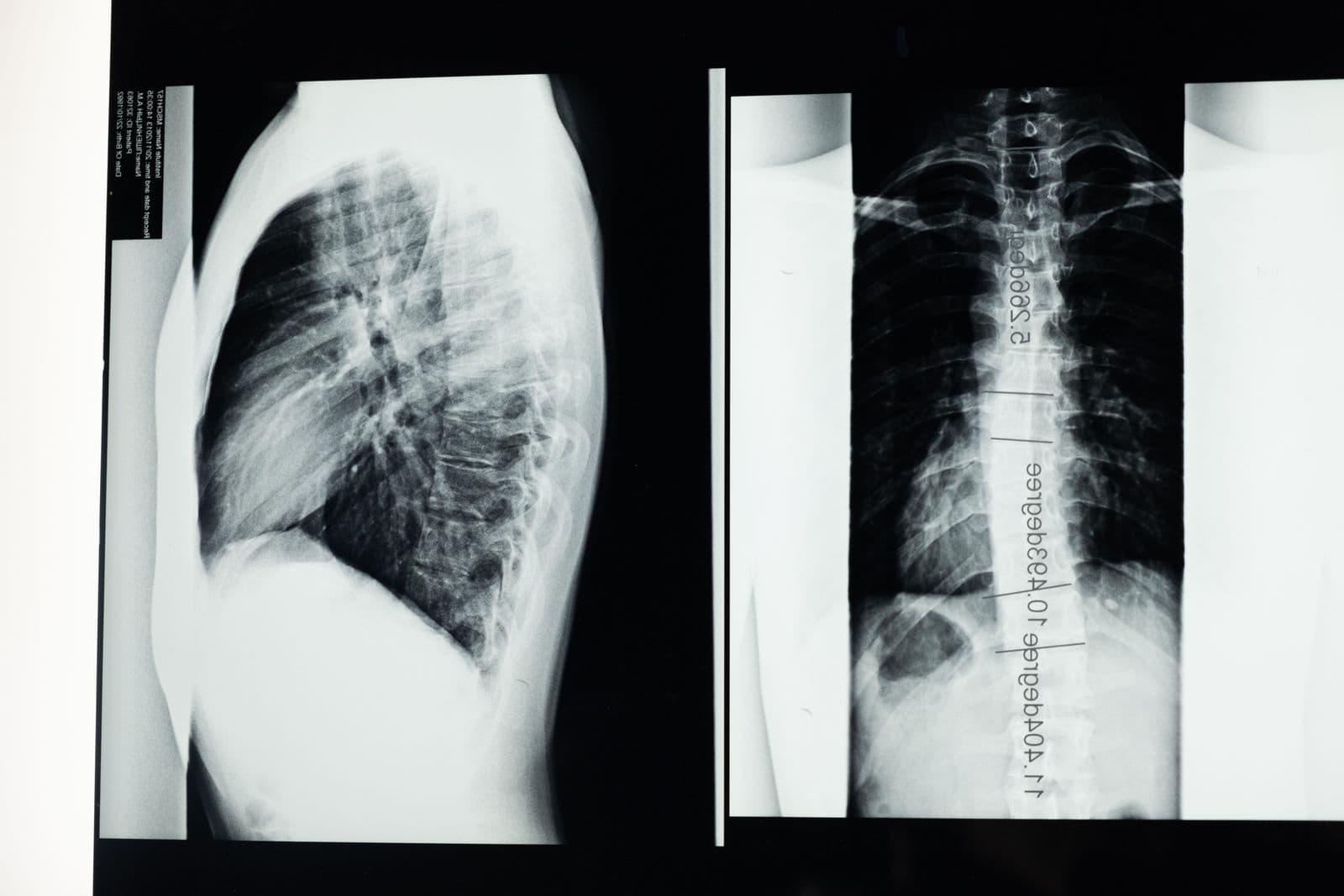
Kinesiology Tape for Posture: What the Trials Actually Show
Three trials measured what elastic tape does to rounded shoulders and forward head posture. The pain relief is real. The lasting angle change is not.
By Nadia Feld, writer, evidence and movement
Published Sep 18, 2026 · 13 min read
- Updated September 18, 2026
- 13 min read
In this guide
A strip of elastic tape costs a few dollars a session, takes ninety seconds to apply, and does not look like a medical device, which is most of its appeal against a canvas-and-buckle brace you have to explain to a coworker. The packaging pitch is that it "lifts the skin," "facilitates" the right muscles, and holds the shoulder in a corrected position for days. Some of that is a real, measurable mechanical effect. The part about holding a correction is where the trial evidence and the packaging copy stop agreeing.
What the tape is actually doing, mechanically
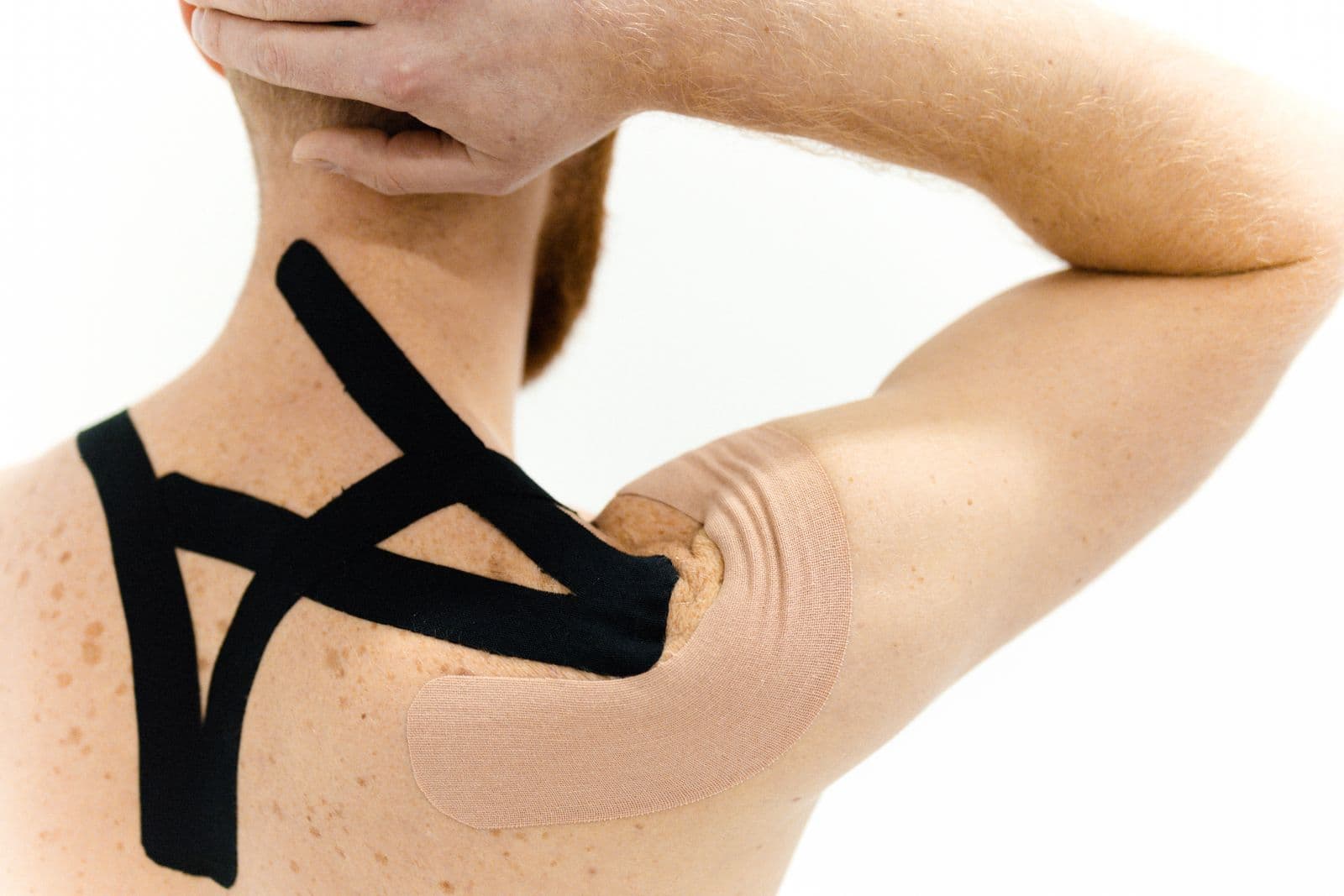
Kinesiology tape is not a splint and applies almost no restrictive force compared with rigid strapping. What it does is stretch to 30 to 40 percent beyond its resting length before application, then recoil against the skin once stuck down, creating a low-grade, sustained pull on the skin and fascia beneath it. The stated mechanisms are a mild lift of the epidermis (theorised to help local circulation) and continuous cutaneous feedback meant to cue a better position without conscious effort, the same proprioceptive logic behind a posture-corrector strap, just delivered through adhesive instead of elastic webbing.
That mechanism is testable, and three trials have tested different pieces of it.
The immediate effect is real, and it is mechanical
Han and colleagues at Kyung-Sung University ran the trial closest to a desk job: fourteen men who worked at least seven hours a day seated, all screened for rounded shoulder posture. Each man's shoulders were randomly assigned to two taping conditions on the same body, so every subject acted as their own control: one shoulder got kinesiology tape applied at 35 to 40 percent stretch, the other got the identical tape applied with no stretch at all, as a placebo. Researchers then measured pectoralis minor length, a supine rounded-shoulder distance, and total scapular distance before and immediately after.
The stretched tape produced a significant improvement across all three measures. The unstretched, placebo-taped shoulder did not move. That is a clean result: the tension in the tape, not the presence of adhesive on skin, is doing the mechanical work, and it does something measurable within minutes.
A larger trial pushes the same finding further. Demircioğlu and Genç randomized 114 people with round shoulder posture and diagnosed subacromial shoulder impingement into a real kinesiology-tape group and a sham-tape group, then remeasured everyone 30 minutes later. Pain dropped from a mean Visual Analog Scale score of 4.73 to 3.40 in the taped group against 4.56 to 3.72 in the sham group, a difference that held up statistically between groups (p = .002). Posture, scored on the New York Posture Rating Chart, moved from 51.07 to 53.21 in the taped group and barely at all in the sham group (p = .040 between groups). Shoulder-abduction proprioception improved significantly in the taped group and not in the sham group (p = .023). A second proprioception measure, flexion angle, improved in both groups about equally, which the authors did not credit to the tape.
Immediate, single-application, real tension against no tension: both trials agree. That much of the marketing claim clears the bar.
The sustained-wear evidence is where it gets honest
What a thirty-minute measurement cannot tell you is whether the correction holds, or whether it changes anything that matters after the tape comes off. Two trials looked further out, and both complicate the story.
Augustsson and colleagues ran a small randomized controlled trial in 26 sedentary workers and students with neck, back or shoulder pain, applying a postural taping product in five three-day cycles over roughly nineteen days. Pain improved meaningfully in the taped group, from a median score of 5 to 2.5 on a 0-to-10 scale (p = .003), against no significant change in the untreated control group (between-group p = .008). The craniovertebral angle, the direct measurement of forward head posture, moved from 33 to 37 degrees in the taped group, which sounds like the same story. It was not statistically significant (p = .058), with no significant difference between groups at follow-up. Three weeks of near-continuous wear reduced pain and did not measurably change the posture it was taped to correct.
That result rhymes with what the tape-versus-exercise trial covered elsewhere on this site found for rounded shoulders: a four-week trial taped two groups twice weekly and gave a third the same home exercise program with no tape. The exercise-only group closed as much of the shoulder-protraction gap as either taped group, and the authors could not recommend taping for a durable correction. Across both independently run trials, the pattern is the same: pain relief shows up reliably, structural correction that survives past the measurement window does not. Forward head posture has its own body of exercise trials measured against the same craniovertebral angle, and that evidence is worth reading on its own terms rather than assuming tape and exercise are interchangeable.
| Measure | Immediate (single application) | Sustained (weeks of wear) |
|---|---|---|
| Pain | Reduced, statistically significant vs sham (Demircioğlu & Genç, 2024) | Reduced, statistically significant vs control (Augustsson et al., 2022) |
| Posture score / angle | Improved vs sham on validated posture scale (Demircioğlu & Genç, 2024) | Not statistically significant vs control on craniovertebral angle (Augustsson et al., 2022) |
| Rounded-shoulder distance | Improved vs unstretched placebo on the same body (Han et al., 2015) | No advantage over exercise alone at 4 weeks (Gunaydin et al., 2023) |
| Mechanism confirmed | Yes — stretch vs no-stretch tape isolates the tension effect | Unclear whether skin tension alone changes load-bearing posture over time |
What this means if you are deciding whether to use it
If the goal is a same-day nudge, before a long presentation, a flight, or a shift where you know your shoulders will round forward and you want a physical reminder, the evidence supports it doing exactly that: a measurable pull on the skin that correlates with less pain and a better score on a posture chart for at least half an hour. That is a real, if modest, use case, and it is a cheap one. It is also a narrower one than a posture corrector built for a full workday, which trades the tape's discretion for a mechanism you can adjust or remove at will rather than re-taping from scratch.
If the goal is fixing rounded shoulders or forward head posture for good, the trial that ran long enough to test that question found the tape did not outperform three weeks of doing nothing, on the actual angle. And the trial that compared tape head-to-head against a home exercise program over four weeks found the exercise arm improved just as much as the taped arms did. Scapular retraction work you can do yourself has the stronger claim on your money and your effort here, not because tape is fake, but because nothing in the tape literature shows it doing work an unloaded strip of elastic couldn't be expected to do once the sensory novelty wears off.
The two are not mutually exclusive. Tape as a cheap, temporary cue on a bad day, alongside the exercise program with the better long-run data, is defensible. Tape as a monthly subscription in place of exercise is the version the evidence does not back.
How to actually apply it, if you're trying it
The taping protocols in the trials above are more specific than most demonstrations. Han's protocol stretched the tape to 35 to 40 percent of its resting length. The no-stretch arm of the same study moved nothing. That single number is the difference between a placebo strip and one that works.
- Clean, dry skin, free of lotion, and shave the area first if body hair will lift the adhesive early.
- Round the corners of any strip you cut yourself. Square corners peel first and take the rest of the strip with them.
- Anchor the first inch or two with no stretch at all, then apply the working length of the strip at 30 to 40 percent stretch, and finish the last inch unstretched again.
- Rub the strip firmly once it's down. The adhesive is heat-activated and needs friction, not just contact, to set.
- Most kinesiology tape is rated for three to five days of wear including showers, longer than most people actually keep a single strip on before it starts lifting at the edges on its own.

$24.39
Price checked Sep 18, 2026
KT Tape Pro Kinesiology Therapeutic Sports Tape
This is the version most people should start with, precisely because there is nothing to cut. Twenty 10-inch precut strips in a beige that sits closer to skin tone than the bright athletic colors, which matters if you're wearing it under a shirt rather than to the gym.
We may earn a commission on this link. It never changes the ranking.
- Format
- 20 precut 10-inch strips
- Stretch
- Synthetic elastic, rated for the 30-40% stretch protocol
- Wear time
- Manufacturer-rated up to 7 days, water resistant
- Color
- Stealth Beige
What works
- Precut strips remove the cutting-and-rounding step entirely
- Beige is close to discreet under a work shirt
- Widely used in the trials this category has been studied under
What to know
- Precut length may not match your torso, so check against a mirror before committing a strip
- Costs more per application than buying a bulk roll and cutting your own
- Still needs the 30-40% stretch applied correctly, which a precut strip doesn't guarantee on its own

$20.50
Price checked Sep 18, 2026
RockTape Original Water-Resistant Kinesiology Tape
A continuous roll rather than precut strips, which is closer to what the clinical protocols above actually used: a strip cut to the exact length of the muscle being addressed, rather than a fixed 10-inch precut length that may run short or long on a given back.
We may earn a commission on this link. It never changes the ranking.
- Format
- 16.4-foot continuous roll, 2 inches wide
- Stretch
- Elastic cotton-blend, water resistant
- Wear time
- Manufacturer-rated up to 5 days
- Color
- Beige
What works
- Cut-to-length matches the trial protocols more closely than a fixed precut strip
- One roll covers many applications, cheaper per use than precut packs over time
- Cotton-blend backing breathes better under clothing than some synthetic tapes
What to know
- Requires scissors and rounding the corners yourself, an extra step precut strips skip
- Easier to under- or over-stretch a hand-cut strip than a factory precut one
- No application guide included, so the technique above is not printed on the packaging
The bottom line
Kinesiology tape does something real and measurable within the first thirty minutes of application: less pain, a better score on a validated posture chart, and a shoulder that sits measurably less forward, all of it disappearing in the sham-taped comparison group. What it has not shown, across the two trials that kept measuring for weeks instead of minutes, is a durable change in the underlying angle once the tape comes off. If you want the cheapest possible same-day cue before a specific event, it does that job. If you want the shoulders to actually stay back, the exercise program that matched tape's own results in a head-to-head trial is the better use of the same twenty minutes.
Questions people actually ask
Does kinesiology tape actually fix rounded shoulders?
The one trial that measured taping against exercise over four weeks found no advantage for tape: the exercise-only group closed as much of the shoulder-protraction gap as the taped groups did. Tape produces a real, measurable immediate effect but the trial evidence for a lasting structural change is weak.
How long should you leave kinesiology tape on?
Most manufacturers rate their tape for 3 to 5 days including showers. The trial that tested multi-week wear used five 3-day cycles with a 24-hour break between each, rather than one continuous application for weeks at a time.
Is kinesiology tape better than a posture corrector brace?
They work on the same proprioceptive principle through different materials. Neither has strong evidence for a durable correction once removed. The trial evidence on posture corrector braces reaches a similarly narrow conclusion to the tape studies here.
Does the stretch percentage matter when applying kinesiology tape?
Yes, and it's the one variable a controlled trial actually isolated. A 2015 pilot study applied tape at 35-40% stretch to one shoulder and the same tape with no stretch to the other shoulder of the same person. Only the stretched side showed a significant improvement.
Can kinesiology tape cause skin irritation?
It can, particularly with the multi-day wear times most brands are rated for. Clean, dry, unbroken skin and rounded strip corners reduce the risk, but any adhesive tape carries some risk of contact irritation, and it should never go over broken or infected skin.
Sources
- Han JT, Lee JH, Yoon CH, "The mechanical effect of kinesiology tape on rounded shoulder posture in seated male workers: a single-blinded randomized controlled pilot study," Physiotherapy Theory and Practice, 2015, 31(2):120-5. PMID 25264014
- Demircioğlu G, Genç H, "Immediate effects of Kinesio taping on pain, proprioception, and posture in round shoulder individuals with subacromial impingement syndrome: A randomized, double-blinded controlled trial," Medicine, 2024, 103(50):e40498. PMC11651479
- Augustsson SR, Reinodt S, Sunesson E, Haglund E, "Short-term effects of postural taping on pain and forward head posture: a randomized controlled trial," BMC Musculoskeletal Disorders, 2022. PMC8857793
- Gunaydin OE, Ertekin E, Gunaydin G, "Four weeks of exercise regimen for sedentary workers with rounded shoulder posture: a randomized controlled study," Sao Paulo Medical Journal, 2023, 141(3):e2022257. DOI: 10.1590/1516-3180.2022.0257.R1.06072022
As an Amazon Associate we earn from qualifying purchases. We earn a commission on some links, at no extra cost to you. It never changes which products we recommend or how they score. Full disclosure

Who wrote this
Writer, evidence and movement
Nadia Feld writes the evidence side of A Better Posture: what a trial measured, what it did not, and what that leaves you with at 3pm when your upper back aches. She is not a clinician and does not write as one. Her job is to read the paper rather than the press release, quote the actual number, and name the limitation the abstract skipped.
More from NadiaThe standard
How this guide was built
- Manufacturer specification sheets and warranty terms, read in full rather than summarised from a listing.
- Published clinical trials and standards bodies where they exist, cited by name and linked.
- Owner reports at volume, including the one-star reviews, which is where failure modes live.
- Every price checked against the live listing on the date printed beside it.