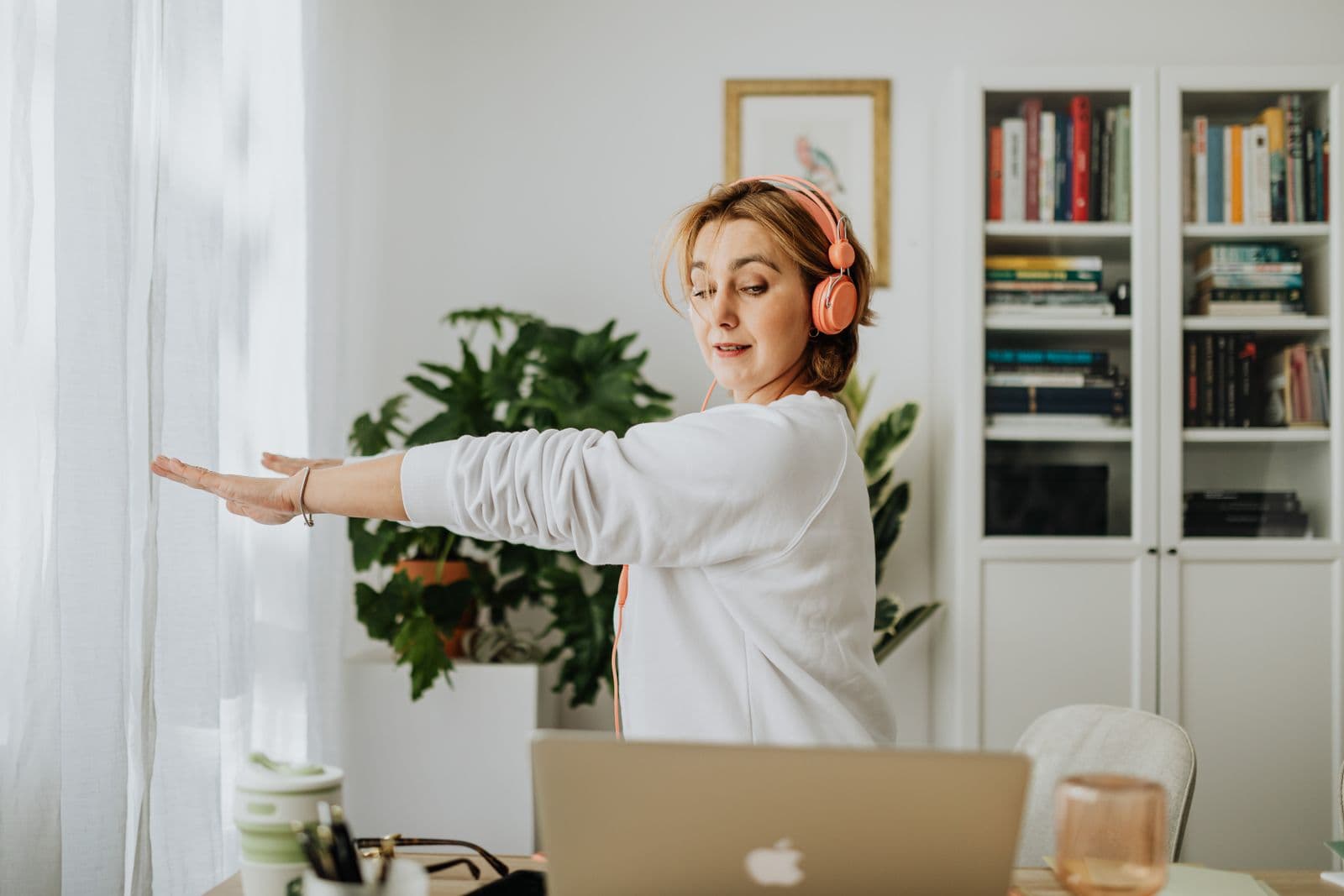
Forward Head Posture: The Exercises With Trial Evidence Behind Them
Craniovertebral angle under 48 degrees is the working definition. Here are the exercises that have been measured against it, and what the numbers actually were.
By Nadia Feld, writer, evidence and movement
Published Apr 16, 2026 · 8 min read
- Updated April 16, 2026
- 8 min read
In this guide
Forward head posture has a measurable definition, which puts it ahead of most things in this category. The measurement is the craniovertebral angle: the angle between a horizontal line through the C7 vertebra and a line from C7 to the tragus of the ear. Researchers commonly treat a craniovertebral angle below 48 degrees as indicating forward head posture.
That matters because it means the exercises can be tested against something objective rather than against how somebody says they feel. A handful have been. What follows is what they found, and what they did not.
What the trials measured
Capital flexion exercise. A 2025 randomised controlled trial in Medicina took 26 stroke patients with forward head posture and gave 13 of them capital flexion exercise on top of standard neurodevelopmental treatment, three sessions a week for six weeks.
The craniovertebral angle in the exercise group went from 45.12 ± 2.73 degrees to 55.81 ± 4.43 degrees (p = 0.001). The control group, receiving standard treatment alone, went from 46.44 ± 1.37 to 50.40 ± 4.58 degrees (p = 0.023). The between-group difference was p = 0.002 with an effect size of d = 1.34, which is large.
Two honest caveats. That population is stroke patients, not desk workers, and 26 participants is small. What it establishes is that a specific movement, done consistently for six weeks, moves the measurement more than doing nothing does. It does not establish the size of that effect in an office worker.
Deep cervical flexor training. A randomised controlled trial of 51 asymptomatic participants with forward head posture compared Bruegger's exercises with elastic resistance, deep cervical flexor training with a pressure biofeedback unit, and isometric neck exercises as a control.
All three groups improved on craniovertebral angle and on the craniocervical flexion endurance test. Deep cervical flexor endurance rose significantly in both the Bruegger's and the deep cervical flexor groups. The interesting finding was at follow-up: the Bruegger's group had held the craniovertebral angle correction longer, at both three and nine weeks.
That last detail is the useful one, and it is the one that does not make it into most exercise lists. Everything improves the angle in the short term. What differs is whether it stays improved.
The exercises, and what each one is doing
| Exercise | What it trains | Evidence status |
|---|---|---|
| Chin tuck / capital flexion | Deep cervical flexors, the muscles that hold the head back over the spine | Measured against craniovertebral angle in RCTs, with significant improvement |
| Craniocervical flexion with biofeedback | The same muscles, with pressure feedback so you know you are using them | Trialled, improves endurance and angle |
| Bruegger's exercise with resistance | Whole-chain extension: thoracic, scapular and cervical together | Held the correction longer than isolated flexor work at 3 and 9 weeks |
| Scapular retraction | Lower and middle trapezius, rhomboids | Commonly prescribed, less directly measured against craniovertebral angle |
| Chest and pec stretching | Reduces anterior tightness that pulls the shoulders forward | Widely used, thin direct evidence for angle change alone |
Chin tuck (capital flexion). Sit or stand tall. Without tipping your chin down, draw your head straight backward, as if making a double chin. You should feel the muscles at the front of your throat engage and a mild stretch at the base of your skull. Hold five to ten seconds. This is the movement the trials measured.
The most common error is nodding rather than translating. Your chin should move backward in a horizontal line, not downward in an arc.
Craniocervical flexion, lying down. The same movement on your back with your head on the floor, which removes gravity as a variable and makes it easier to isolate the deep flexors rather than recruiting the big superficial ones. This is the version done with a pressure biofeedback cuff in a clinic. At home, the cue is that the muscles at the sides of your neck should stay soft.
Bruegger's position. Sit at the edge of a chair, feet apart, arms down and slightly out with palms turned forward and thumbs pointing back. Roll the shoulders back and down, lift the sternum, and gently tuck the chin. With a light resistance band across the backs of the hands it becomes an active exercise rather than a position.
This one trains the whole chain rather than one muscle group, which is the most plausible explanation for why its correction held longer in the trial.
A schedule that matches what was tested
The six-week trial used three sessions a week. The nine-week follow-up study measured retention out to nine weeks. So the honest schedule is not "do these daily forever" but something with a defined block and a follow-up check.
- Weeks 1 to 6: three sessions a week. Ten chin tucks, held five seconds. Ten Bruegger's repetitions, held five seconds. Five minutes total.
- Week 6: have somebody photograph you from the side, standing relaxed, and compare it against a photograph from week one. This is the amateur version of measuring the craniovertebral angle, and it is enough to see a ten-degree change.
- After week 6: drop to twice a week and check again at week nine.
Five minutes, three times a week, for six weeks. That is the dose that has been tested. Anything longer or more frequent is your choice and is not what the trials did.
The part the exercises cannot do
Your head drifts forward at a desk for a reason, and the reason is usually that your screen is below your eye line and your torso has rotated to meet it.
Six weeks of chin tucks against eight hours a day of a laptop on a table is not a fair fight. The published screen height targets take six minutes to check and cost nothing to hit, and they remove the mechanical reason the exercises are working against.
The same goes for the chair. A pelvis rolled backward takes the whole spine with it, and the head goes forward at the top of that chain regardless of how strong the deep flexors are. Nine minutes with the levers is the prerequisite, not the follow-up.
And if you were considering a brace instead, know what you are choosing between: a strap reduces the work your postural muscles do while worn, and these exercises increase it. Those are opposite interventions and it is worth being deliberate about which one you want.
Questions people actually ask
How long does it take to correct forward head posture?
The trial that measured it used six weeks at three sessions a week and produced a change in craniovertebral angle of roughly ten degrees in the exercise group. That was 26 stroke patients rather than desk workers, so treat six weeks as the tested duration rather than a promise about your own result.
Do chin tucks actually work?
Chin tucks, or capital flexion, are the movement most directly measured in the trials, and they produced significant improvement in craniovertebral angle against a control. The caveat is that the improvement was measured while the programme was running, and retention past that varies by which exercise was used.
Which exercise holds the correction longest?
In the trial comparing them, the Bruegger's exercise group maintained the craniovertebral angle correction longer than the isolated deep cervical flexor group at both three and nine weeks. The plausible reason is that it trains the whole chain rather than one muscle group, but the trial did not test that explanation.
How do I know if I have forward head posture?
The research definition is a craniovertebral angle below 48 degrees, measured from a side-on photograph between a horizontal line at C7 and a line from C7 to the ear. At home, a side-on photograph standing relaxed against a doorframe will show you the same thing approximately, and it is enough to compare against a photograph six weeks later.
Can exercises fix forward head posture permanently?
No trial has followed people long enough to answer that. What has been shown is a measurable change over six weeks and partial retention at nine. Permanence has not been demonstrated by anybody, and the desk you sit at for eight hours a day is working against you the whole time.
Sources
- Hyeon D-A, Kim J-S, Lim H-W, "Effects of Capital Flexion Exercise on Craniovertebral Angle, Trunk Control, Balance, and Gait in Stroke Patients with Forward Head Posture: A Randomized Controlled Trial", Medicina (Kaunas), 2025;61(5):797. PMC12113511
- "Bruegger's exercises vs deep cervical flexor training in asymptomatic participants with forward head posture: a randomised controlled trial", International Journal of Therapy and Rehabilitation, 2022, doi:10.12968/ijtr.2020.0149. Indexed at PubMed
- "Upper cervical and upper thoracic spine mobilization versus deep cervical flexors exercise in individuals with forward head posture: A randomized clinical trial", 2019. PubMed 30584118
- OSHA Computer Workstations eTool, for the workstation targets referenced in the final section.
As an Amazon Associate we earn from qualifying purchases. We earn a commission on some links, at no extra cost to you. It never changes which products we recommend or how they score. Full disclosure

Who wrote this
Writer, evidence and movement
Nadia Feld writes the evidence side of A Better Posture: what a trial measured, what it did not, and what that leaves you with at 3pm when your upper back aches. She is not a clinician and does not write as one. Her job is to read the paper rather than the press release, quote the actual number, and name the limitation the abstract skipped.
More from NadiaThe standard
How this guide was built
- Manufacturer specification sheets and warranty terms, read in full rather than summarised from a listing.
- Published clinical trials and standards bodies where they exist, cited by name and linked.
- Owner reports at volume, including the one-star reviews, which is where failure modes live.
- Every price checked against the live listing on the date printed beside it.