Scapular Retraction Exercises for Rounded Shoulders: What a Trial Actually Found
A four-week RCT in 39 sedentary workers measured rounded shoulders before and after. The exercise-only group improved as much as the taped groups did.
By Nadia Feld, writer, evidence and movement
Published Aug 27, 2026 · 9 min read
- Updated August 27, 2026
- 9 min read

In this guide
Rounded shoulders has a measurement, which is more than most posture complaints can say. Lie on your back, and someone measures the vertical distance from the table to the front of your shoulder (the acromion). More than 3 centimeters of gap between two testing points is the threshold a 2015 study used to define the condition, and it is the one a 2023 randomized controlled trial in Sao Paulo Medical Journal used to screen its participants.
That trial is worth reading closely, because it tested the two things people actually buy for rounded shoulders against each other: kinesiology tape and a home exercise program. The result was not what the tape brands would want printed on the box.
What the trial did
Researchers at Aydın Adnan Menderes University in Turkey recruited 52 sedentary workers aged 18 to 34, screened them for rounded shoulder (RS) posture using the acromion-testing table method, and randomized 45 of them into three groups. Thirty-nine finished the full four weeks.
Two groups got their shoulders taped twice a week with elastic corrective tape, in addition to a home exercise program. The third group, the control, did the home exercise program alone, with no tape.
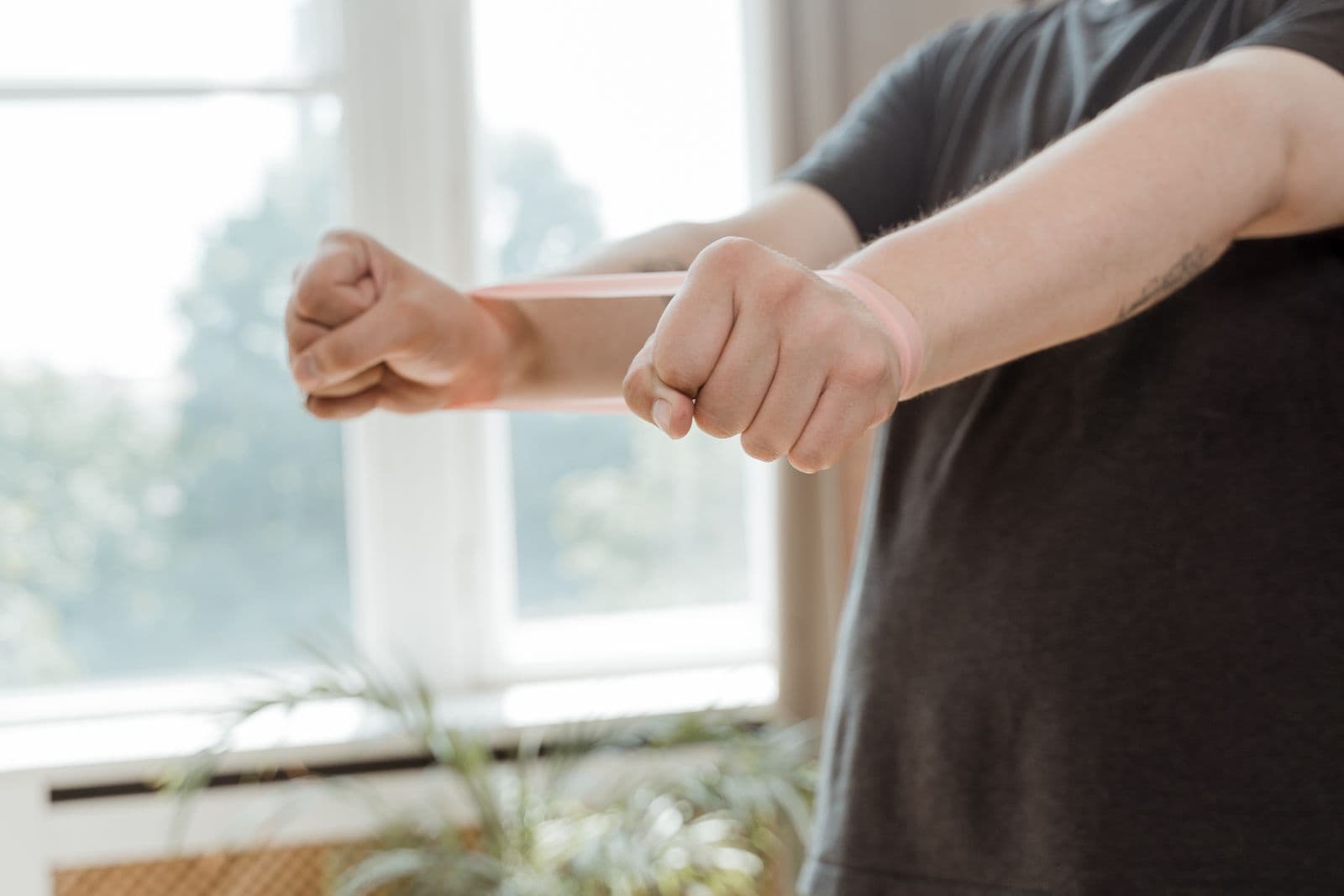
The exercise program was the same for everyone, and it was not complicated. Three movements, prescribed twice a day for four weeks:
| Exercise | How | Dose |
|---|---|---|
| 'W' wall slides | Back flat against a wall, arms bent into a W shape, slide upward without losing wall contact, return to the W | 3 sets x 15, twice daily |
| Shoulder retraction | Elbows bent 90 degrees at your sides, squeeze the shoulder blades together for 5 seconds without shrugging, release | 3 sets x 15, twice daily |
| Backward shoulder rolls | Arms at your sides, elbows bent, roll the shoulders up, back, and down in a full circle, continuously | 3 sets x 2 minutes, twice daily |
Researchers measured acromion-testing (AT) distance, a shoulder angle taken by smartphone photogrammetry, and muscle stiffness in the upper trapezius and pectoralis minor using shear wave elastography, at baseline and again at four weeks.
What actually moved
Every group improved on the primary measure. AT distance, the direct measurement of how far the shoulder sits forward, dropped significantly in all three:
- Performance-tape group: 6.10 cm to 5.05 cm, a 1.05 cm reduction (Cohen's d = 1.02, a large effect)
- Classic-tape group: 6.40 cm to 5.55 cm, a 0.85 cm reduction (d = 0.69)
- Exercise-only control group: 6.48 cm to 5.58 cm, a 0.90 cm reduction (d = 0.67)
Read that middle number again against the third. The control group, which received no tape at all, improved by almost exactly as much as the classic-tape group and not meaningfully less than the performance-tape group. The paper's own post-hoc analysis found no statistically significant difference between any of the three groups at four weeks. The authors' conclusion, stated plainly: "prescribing corrective postural exercises will be more effective for the treatment of muscle stiffness that develops secondary to postural disorders" than adding tape, and the study team said outright they "do not recommend the use of scapular [mechanical correction taping] with the expectation of corrective and muscle stiffness regulatory effects in the long term."
The shoulder-angle result was messier and worth being honest about. It improved significantly in the performance-tape group (61.25 to 68.19 degrees, d = 0.76) and in the control group (57.91 to 66.09 degrees, d = 1.06), but not in the classic-tape group. Because the largest numerical gain landed in the no-tape control, the authors concluded they "cannot conclude that the angular change was due to taping" and instead attributed it to the exercise program itself.
Muscle stiffness, measured directly with ultrasound elastography rather than inferred, told a similar story: where it improved, it improved in the control group as often as in the taped groups, with no consistent advantage for either tape fabric.
What this does and does not prove
One four-week trial in 39 healthy adults aged 18 to 34 is not the last word on rounded shoulders, and the paper says so itself: no comparison group of people without RS posture, and screening done by a linear distance measurement rather than the angular measurement some comparable studies use. It is also short. Four weeks tells you what happens fast, not what holds at six months.
What it does support, cleanly, is the comparison it was built to make. Against a well-supervised taping protocol, applied twice weekly by a certified practitioner for a month, unsupervised home exercise performed roughly as well. If the tape were doing meaningful independent work, the exercise-only control should have lagged behind the taped groups. It didn't.
That is consistent with the broader mechanism the researchers point to: rounded shoulder posture is associated with overactive, stiff upper trapezius and pectoralis minor working against a weak lower trapezius and rhomboids. Scapular retraction and depression directly loads the muscles on the weak side of that pair, which is a more plausible route to change than a strip of tape providing sensory feedback. It is also the capacity a brace leaves untouched, since wearing one does not build the weak side of that pair.
How to run the program yourself
The three exercises above are unchanged from the trial protocol, and the dose that produced the measured result was specific: three sets of fifteen repetitions (or two continuous minutes for the shoulder rolls), performed twice a day, for four weeks. That is a higher volume than most desk-break routines ask for, and it is worth naming as the actual cost of the result above rather than rounding it down to "a few reps when you remember."
Wall slides are the one most people get wrong. The failure is losing contact between the arm and the wall as it slides up, which lets the shoulder substitute for the upper back. Keep the entire forearm on the wall through the whole range, even if that means a shorter range than you'd get by cheating it.
Shoulder retraction fails in the other direction: shrugging instead of retracting. The cue that works is imagining you're sliding the shoulder blades down and into your back pockets, not up toward your ears. The same cue shows up in the scapular retraction stretch already on this site, because it's the same muscle target.
Backward shoulder rolls are the easiest to do absent-mindedly at a desk, on a call, waiting for a page to load, which makes them the one most likely to survive four weeks of real life.
None of this replaces addressing why the shoulders rounded in the first place. Upper crossed syndrome is the model most often invoked here, and it's worth reading the limits of that model before assuming it explains your specific case. If your screen sits low enough to pull your head and shoulders forward for eight hours a day, the exercises are working against a setup that resets the pattern daily. And if what actually gets in the way of any four-week program is remembering to do it, the compliance data on desk interventions is worth reading before you commit to a schedule you won't keep.
For the related and frequently confused question of forward head posture specifically, the craniovertebral-angle trials are a separate body of evidence with their own exercise, the chin tuck, and their own numbers.
Questions people actually ask
Does kinesiology tape help fix rounded shoulders?
In the trial measured here, no: taped groups improved by about the same amount as the exercise-only control group, and the authors found no statistically significant advantage for either tape fabric over exercise alone at four weeks.
How long does it take to see a change in rounded shoulder posture?
In this trial, a significant reduction in shoulder protraction (AT distance) was measurable at four weeks, with two sessions a day. That is the shortest timeframe with trial data behind it. The study did not follow participants past four weeks, so how durable the change is remains unmeasured.
What is a normal AT distance for shoulder posture?
The trial used greater than 3 cm as the threshold for rounded shoulder posture, based on the acromion-testing table method from prior research. It's a clinical screening measurement, not something to self-diagnose from without a proper testing table and a second person to measure it.
Do I need to strengthen or stretch for rounded shoulders?
The trial protocol was entirely strengthening and mobility work: wall slides, shoulder retraction, and shoulder rolls, with nothing held as a passive stretch. That is a different emphasis from a general upper-back stretching routine, and it is the version with RCT evidence behind the specific outcome of shoulder protraction.
How often do I need to do the exercises?
The measured protocol was twice daily for four weeks: three sets of fifteen repetitions for the wall slides and shoulder retraction, and three sets of two continuous minutes for the shoulder rolls. Lower frequency wasn't tested, so there's no trial evidence for what a lighter dose produces.
Sources
- Gunaydin OE, Ertekin E, Gunaydin G, "Four weeks of exercise regimen for sedentary workers with rounded shoulder posture: a randomized controlled study," Sao Paulo Medical Journal, 2023;141(3):e2022257. DOI: 10.1590/1516-3180.2022.0257.R1.06072022
- OSHA Computer Workstations eTool, for the working posture targets this program's exercises are meant to counteract.
As an Amazon Associate we earn from qualifying purchases. We earn a commission on some links, at no extra cost to you. It never changes which products we recommend or how they score. Full disclosure

Who wrote this
Writer, evidence and movement
Nadia Feld writes the evidence side of A Better Posture: what a trial measured, what it did not, and what that leaves you with at 3pm when your upper back aches. She is not a clinician and does not write as one. Her job is to read the paper rather than the press release, quote the actual number, and name the limitation the abstract skipped.
More from NadiaThe standard
How this guide was built
- Manufacturer specification sheets and warranty terms, read in full rather than summarised from a listing.
- Published clinical trials and standards bodies where they exist, cited by name and linked.
- Owner reports at volume, including the one-star reviews, which is where failure modes live.
- Every price checked against the live listing on the date printed beside it.