Neck and Shoulder Strength Training for Desk Workers: What the Office Trials Found
Five office-worker trials compared strength training, stretching and general fitness for desk neck pain. Loading the muscle won, even at two minutes a day.
By Nadia Feld, writer, evidence and movement
Published Sep 29, 2026 · 12 min read
- Updated September 29, 2026
- 12 min read
In this guide
The usual advice for a sore neck at a desk is to stretch it. Roll the head, pull an ear toward a shoulder, hold for thirty seconds, repeat when it tightens up again.
It is also the option with the weakest trial record. When researchers in Finland and Denmark set stretching and general fitness against direct strength work for the neck and shoulder muscles in office workers, the loading programmes won repeatedly, and one of them won with a dose of two minutes a day.
One thing to set out first. These trials measured pain, tenderness and strength. None of them measured posture in the sense of a head angle or a shoulder position. If your question is whether you can change the craniovertebral angle, that is a separate body of evidence built around the chin tuck. This one is about the ache.
The Finnish trial: 180 office workers, 12 months
The largest long trial is Ylinen and colleagues, published in JAMA in 2003. They recruited 180 female office workers aged 25 to 53 with chronic, nonspecific neck pain through occupational health services in southern and eastern Finland, and randomised 60 to each of three groups.
- Endurance group: dynamic neck exercises, mainly lifting the head up from lying face-up and face-down.
- Strength group: high-intensity isometric neck exercises against an elastic band, pressing the head into the band's resistance without moving.
- Control group: advice only.
Both training groups also did dumbbell exercises for the shoulders and upper limbs. And every group, including the controls, was told to do aerobic exercise and stretching three times a week. So the control group was doing exactly what most people with a stiff neck are told to do.
At 12 months, neck pain and disability had fallen in both training groups compared with the controls (p below 0.001). The strength numbers separated the groups sharply.
| Group | Neck flexion strength | Rotation strength | Extension strength |
|---|---|---|---|
| Isometric strength training | +110% | +76% | +69% |
| Dynamic endurance training | +28% | +29% | +16% |
| Stretching and aerobic advice | +10% | +10% | +7% |
The authors put the conclusion plainly: stretching and aerobic exercise alone "proved to be a much less effective form of training than strength training." Only the strength group also gained a statistically significant range of motion in side-bending, flexion and extension, which is worth noting for anyone who stretches precisely because the neck feels like it will not turn.
The Danish trials: which muscle, and how little
The National Research Centre for the Working Environment in Copenhagen ran a sequence of trials that sharpen the Finnish result in two directions: whether the exercise has to load the painful muscle itself, and how small a dose still works.
Loading the painful muscle versus general fitness
Andersen and colleagues, in Arthritis and Rheumatism in 2008, recruited 48 employed women with a clinical diagnosis of trapezius myalgia (pain in the upper trapezius, the muscle running from the neck to the point of the shoulder) from seven workplaces with monotonous, computer-heavy jobs. For 10 weeks they were randomised to one of three things: specific strength training aimed at the painful muscle, general fitness training done as leg cycling with the shoulders relaxed, or a reference intervention with no physical activity.
The strength group's worst pain score dropped by 35 mm on a 100 mm scale, roughly 79%. The cycling group got a small, temporary drop of 5 mm right after sessions, and nothing that lasted. Getting fitter did not fix a painful trapezius. Loading the trapezius did.
What happens at a whole workplace over a year
The same group then scaled up. A one-year trial in Medicine and Science in Sports and Exercise (2008) randomised 549 office workers to specific resistance training for the neck and shoulders (180), all-round physical exercise (187), or general health counselling (182).
Among people who started with neck pain, specific resistance training brought pain intensity from 5.0 to 3.4 on a 0 to 9 scale, and all-round exercise brought it from 5.0 to 3.6. Counselling changed nothing. Shoulder elevation strength rose 9% to 11% in both exercise groups. Among people who started without shoulder pain, the counselling group developed more of it over the year than either exercise group, which is the closest thing in this literature to evidence for prevention rather than treatment.
The more sobering numbers are about attendance. Regular participation in the first half-year was 54% for the resistance group and 31% for all-round exercise. In the second half it fell to 35% and 28%. A programme that works in the people who do it still has to be done, and most people in a real office stopped.
Two minutes against twelve
That attendance problem is what the next trial was built to attack. Andersen and colleagues, in Pain in 2011, randomised 198 adults (174 women, 24 men) working at least 30 hours a week with frequent neck and shoulder pain to elastic-tubing resistance training for either 2 minutes or 12 minutes a day, five days a week, or to weekly general health information by email. The trial ran 10 weeks.
| Outcome vs control at 10 weeks | 2 minutes a day | 12 minutes a day |
|---|---|---|
| Neck/shoulder pain (0 to 10 scale) | -1.4 points | -1.9 points |
| Muscle tenderness (0 to 32 score) | -4.2 points | -4.4 points |
| Isometric strength | +2.0 Nm | +1.7 Nm |
Six times the training time bought about half a point more pain relief and no extra strength. The authors' conclusion was that "as little as 2 minutes of daily progressive resistance training for 10 weeks results in clinically relevant reductions of pain and tenderness."
What the two-minute session actually is
A 2013 follow-up in BioMed Research International (Lidegaard and colleagues) took 30 women from that trial (15 training, 15 controls) and described the two-minute protocol in detail. It is one exercise.
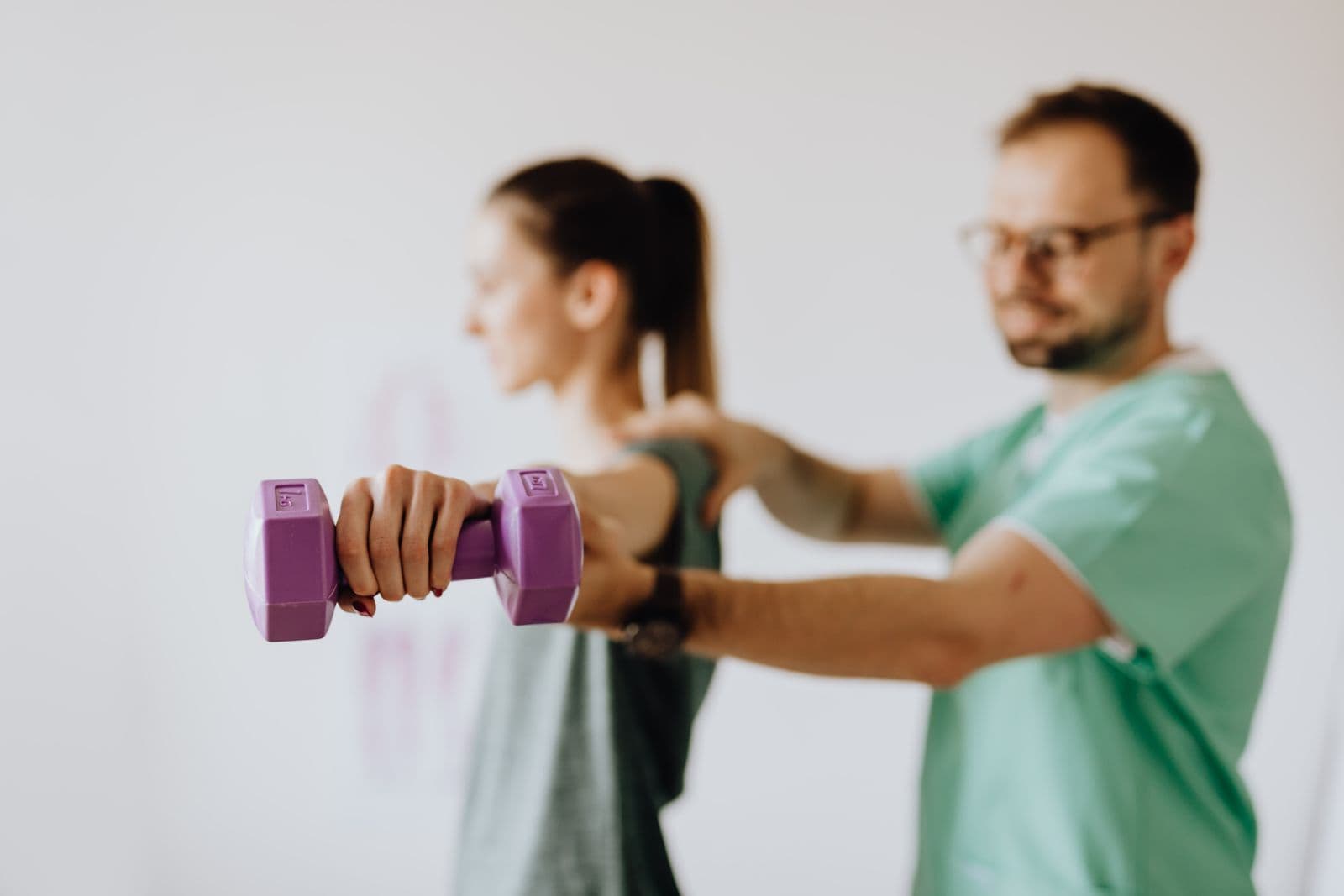
- Movement: a lateral raise in the scapular plane, lifting the arms out to the side and slightly forward (the scapular plane), against Thera-Band elastic tubing.
- Dose: a single set, as many consecutive repetitions as possible to momentary fatigue, for a maximum of two minutes.
- Frequency: on workdays, during working hours.
- Progression: participants logged every session so repetitions and resistance could rise over time.
Adherence was 86%, far above the year-long trial's numbers, which is the point of making the session this short. Against controls, the training group gained 6% isometric strength and reported 40% less neck and shoulder pain.
The same paper recorded muscle activity through a normal workday, and the result is the most interesting thing in it. In the hours right after a session the neck muscles were, if anything, more tense. But at 10 weeks the splenius (a neck extensor) was spending far more of the working day completely switched off: the average length of those full-relaxation gaps rose 71%. A stronger muscle doing the same desk work seems to get more rest during it.
The lateral raise is a reasonable default because the researchers chose it for covering most of the neck and shoulder musculature with one movement. It pairs well with the scapular retraction work that has its own four-week trial for rounded shoulders, which loads the mid and lower trapezius from a different angle. For choosing the tubing, the resistance band comparison on this site covers which formats handle a lateral raise and which do not.
What the Cochrane review adds
The 2015 Cochrane review of exercise for mechanical neck disorders (Gross and colleagues) pooled 27 trials with 2,485 analysed participants.
For chronic neck pain, it found moderate-quality evidence that strength training for the neck, shoulder-blade region and upper limbs improves pain by a moderate to large amount immediately after treatment, with a pooled standardised mean difference of -0.71. Endurance training for the same region had a slight benefit. On the other side, low-quality evidence suggested that stretching alone, general fitness training and breathing exercises may not change pain or function in the short term.
The review also said what the individual papers could not. No high-quality evidence was found for any exercise approach, so real uncertainty remains. For acute neck pain (a recent onset, rather than something that has hung around for months) it found no evidence either way. And it named the optimal dose as an open question, which is exactly the one the two-minute trial started to answer.
Where the evidence is thin
Mostly women. The Finnish trial and the 2008 trapezius trial were women only, and the two-minute trial was 88% women. The Danish authors cite cohort evidence that being a woman is among the strongest predictors of developing neck pain in computer work, partly because a given workload is a larger share of a smaller maximum strength. Whether the effect sizes carry over to men unchanged is not something these samples can say.
Nobody was blinded. You cannot hide from a participant that they are lifting weights. The 2013 paper names placebo and Hawthorne effects as live possibilities for the pain scores. The strength gains and the muscle-activity recordings are harder to talk yourself into, which is partly why they matter.
Pain, not posture. None of these trials measured head position or shoulder protraction. A reduction in neck pain does not show that anybody's posture changed, and the link between posture and pain is weaker than most people assume in the first place.
Chronic, nonspecific pain only. Participants were screened for serious disease and injury. That is the population these results describe.
A workable version at a desk
Pick a loading exercise, not a stretch. A lateral raise with light tubing or a light dumbbell is the one with the most direct evidence behind it. Isometric presses of the head into a band's resistance are what the Finnish strength group did.
Take each session to real effort. The two-minute protocol was a set to fatigue, not two relaxed minutes of lifting. If the last few repetitions are not hard, the load is too light.
Log it and progress. Participants recorded every session so they could add repetitions or resistance. Without a record, a programme drifts back to whatever felt comfortable in week one.
Attach it to something that already happens. The year-long trial lost most of its participants to attendance, not to ineffectiveness. Anchoring a short routine to a fixed point in the day is the part the research leaves to you.
Keep the stretches if you like them, but do not count them. They are pleasant and cost nothing, and the trials above do not show they help the pain on their own.
Questions people actually ask
Is stretching or strengthening better for neck pain at a desk?
In the trials that compared them directly, strengthening. The Finnish JAMA trial gave its control group stretching and aerobic advice and found pain and disability fell significantly more in both training groups over 12 months. The 2015 Cochrane review rated stretching alone as low-quality evidence of little or no short-term effect.
How long do neck strengthening exercises take to reduce pain?
The Danish trials measured a significant reduction at 10 weeks. The Finnish trial measured at 12 months. None of these trials reported a shorter timepoint that isolates when the benefit first appears.
Is two minutes a day really enough?
In a 198-person randomised trial, two minutes of elastic-tubing lateral raises five days a week reduced pain by 1.4 points on a 10-point scale against control, compared with 1.9 points for twelve minutes a day. The session was one set taken to fatigue, and resistance was progressed over the 10 weeks.
Does cycling or general exercise help neck pain?
Not much, going by the Danish trapezius trial. Leg cycling with relaxed shoulders gave a small, short-lived drop in pain right after each session, while strength training aimed at the painful muscle cut the worst pain score by about 79% over 10 weeks.
Will neck strengthening improve my posture?
These trials did not measure it. Their outcomes were pain, tenderness, strength and muscle activity. Evidence on changing head or shoulder position comes from different trials using exercises such as the chin tuck and scapular retraction.
Sources
- Ylinen J, Takala EP, Nykanen M, et al., "Active neck muscle training in the treatment of chronic neck pain in women: a randomized controlled trial," JAMA, 2003, 289(19), 2509-2516. doi:10.1001/jama.289.19.2509
- Andersen LL, Kjaer M, Sogaard K, et al., "Effect of two contrasting types of physical exercise on chronic neck muscle pain," Arthritis and Rheumatism, 2008, 59(1), 84-91. doi:10.1002/art.23256
- Andersen LL, Jorgensen MB, Blangsted AK, et al., "A randomized controlled intervention trial to relieve and prevent neck/shoulder pain," Medicine and Science in Sports and Exercise, 2008, 40(6), 983-990. doi:10.1249/MSS.0b013e3181676640
- Andersen LL, Saervoll CA, Mortensen OS, et al., "Effectiveness of small daily amounts of progressive resistance training for frequent neck/shoulder pain: randomised controlled trial," Pain, 2011, 152(2), 440-446. doi:10.1016/j.pain.2010.11.016
- Lidegaard M, Jensen RB, Andersen CH, et al., "Effect of brief daily resistance training on occupational neck/shoulder muscle activity in office workers with chronic pain: a randomized controlled trial," BioMed Research International, 2013, 262386. PMC3892746
- Gross A, Kay TM, Paquin JP, et al., "Exercises for mechanical neck disorders," Cochrane Database of Systematic Reviews, 2015, CD004250. PMC9508492
As an Amazon Associate we earn from qualifying purchases. We earn a commission on some links, at no extra cost to you. It never changes which products we recommend or how they score. Full disclosure

Who wrote this
Writer, evidence and movement
Nadia Feld writes the evidence side of A Better Posture: what a trial measured, what it did not, and what that leaves you with at 3pm when your upper back aches. She is not a clinician and does not write as one. Her job is to read the paper rather than the press release, quote the actual number, and name the limitation the abstract skipped.
More from NadiaThe standard
How this guide was built
- Manufacturer specification sheets and warranty terms, read in full rather than summarised from a listing.
- Published clinical trials and standards bodies where they exist, cited by name and linked.
- Owner reports at volume, including the one-star reviews, which is where failure modes live.
- Every price checked against the live listing on the date printed beside it.