Kneeling Chairs and Exercise Balls: What the Posture Research Actually Found
Lab studies measured trunk motion, muscle activity and spinal load on an exercise ball versus a normal chair, and the fitness-ball claim didn't hold up.
By Ellis Warner, editor, hardware and workstation geometry
Published Sep 7, 2026 · 9 min read
- Updated September 7, 2026
- 9 min read
In this guide
The claim shows up in nearly identical form on every article about "active sitting": swap your office chair for an exercise ball or a kneeling chair, and your core engages, your posture improves, and the hours of sitting stop doing the damage. It is a specific, testable claim, which means somebody has actually put it in a lab and measured what happens to a spine on a ball instead of a chair. Two separate research groups have. Neither found what the claim predicts.
What the ball is supposed to do, and what it actually does
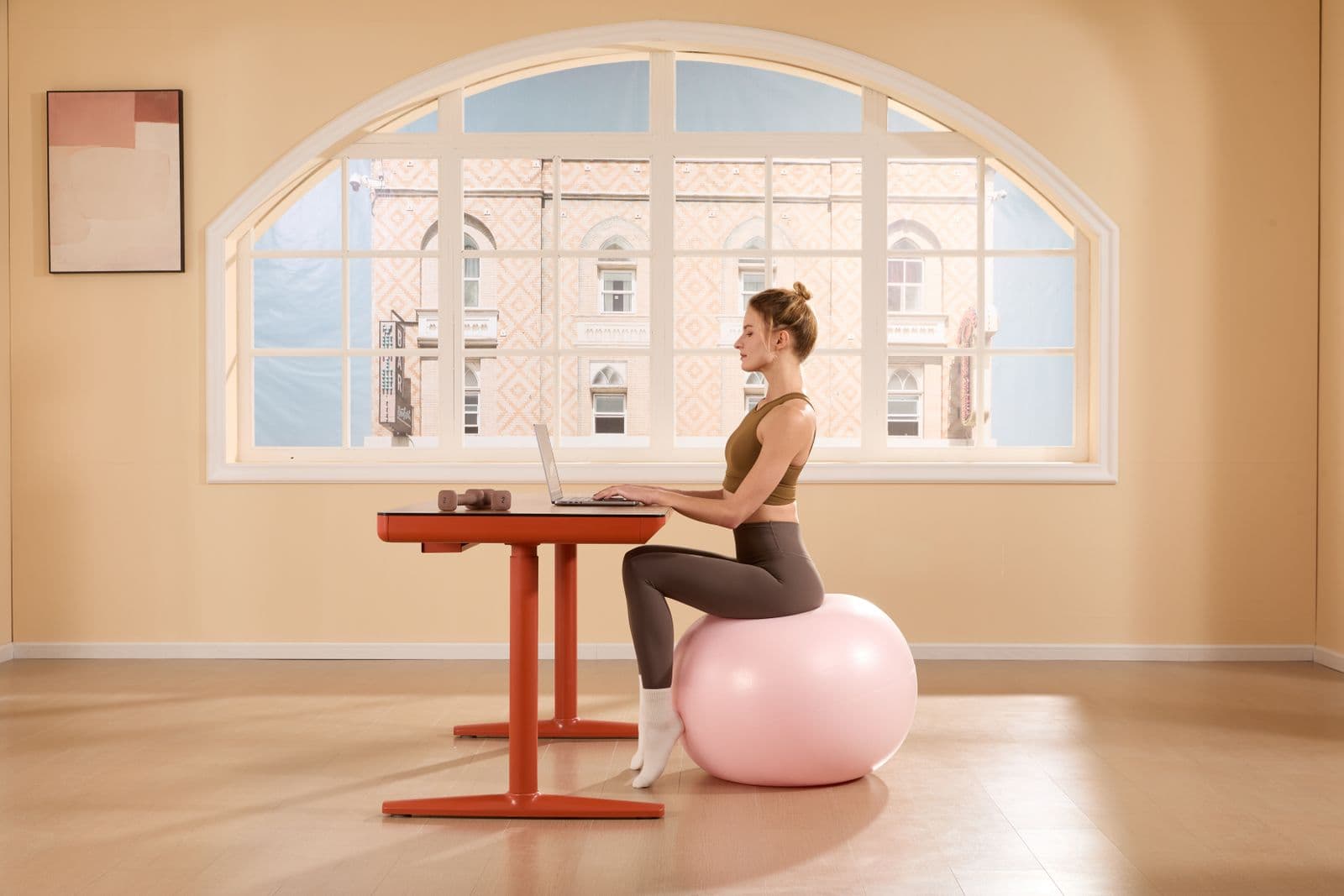
The theory is straightforward: a stable chair lets your trunk go slack, and an unstable base forces your deep stabilizers to keep firing to hold you upright, which is supposed to function like free core training spread across a workday. Kingma and van Dieën tested exactly this in Applied Ergonomics, putting ten women through a one-hour typing task on an office chair with armrests and again on an exercise ball. The ball did produce more activity: 33% more trunk motion and 66% more variation in lumbar muscle activity than the chair, with average lumbar muscle activity 78% higher. It also produced more spinal shrinkage over the hour, the standard lab proxy for compressive load on the spine. More motion and more muscle activity is not automatically a benefit. In this case it came bundled with more load, and the authors concluded the real-world benefit of the swap was negligible.
A separate study reached a similar place from a different angle. Gregory, Dunk and Callaghan measured eight trunk muscles and lumbar spine posture in 14 people doing an hour of computer work on each seat type. Ball sitting produced significantly higher thoracic erector spinae activation (p = .0352), significantly less pelvic tilt (p = .0114), and significantly more perceived discomfort (p < .0001) than the office chair. The authors' own framing was blunt: the biomechanical changes were small, the discomfort increase was not, and prolonged ball sitting "may not be advantageous."
A follow-up study asked the obvious next question: does the ball get better once you're used to it? Twelve people did two two-hour ball-sitting sessions separated by a nine-day accommodation period for half the group. Discomfort ratings dropped in women who'd had the accommodation window. Muscle activity and lumbar posture did not change at all. Getting used to a ball makes it feel less uncomfortable. It does not make it do anything different to your spine.
The occupational health guidance nobody quotes
CCOHS, the Canadian government's occupational health and safety body, has a page on alternative seating that lists exercise balls and kneeling chairs by name, and its disadvantage column for both is longer than its advantage column. For exercise balls specifically, it names the requirement for constant concentration and coordination to hold posture, accelerated fatigue from the active dynamic posture, arm and shoulder fatigue from the lack of arm and back support, and an increased fall risk compared with a normal chair. It does not recommend a duration or frequency for office use beyond following the specific guidance of a health professional, which is a way of saying there is no general-population dose it is prepared to endorse.
Kneeling chairs are a different mechanism, and the evidence is thinner but more favorable
A kneeling chair doesn't ask your trunk to balance against instability the way a ball does. It tilts the seat pan forward and shifts part of your body weight onto a lower shin pad, which opens the angle at the hip and, in theory, makes it easier to hold the lumbar spine's natural curve instead of slumping into a posterior pelvic tilt.
The one pilot study to test this directly found it worked, mechanically. Vaucher and colleagues measured lumbar curvature in ten people with chronic low back pain and ten healthy controls, standing and then sitting on a standard chair and a kneeling chair, in both upright and slouched postures. The kneeling chair preserved more of each person's standing lumbar curve than the standard chair did, in both groups, a real, measured mechanical effect.
It's also a single pilot study: ten people per group, one lab session, curvature measured but pain and long-term outcomes were not. CCOHS's disadvantage list for kneeling chairs is longer than its list for balls: over-flexed knees bearing weight they weren't built to bear, static muscular load, earlier fatigue, reduced reach, pressure pushed onto the wrists and elbows as the user leans onto the work surface, and an explicit instruction not to maintain the position for extended periods. A chair that measurably holds a better spinal curve while asking the knees and wrists to absorb load they weren't designed for is a genuine trade-off, not a strictly better chair.
| Device | What was actually measured | What the evidence supports |
|---|---|---|
| Exercise ball | More trunk motion, more lumbar muscle activity, more spinal shrinkage, more discomfort, no posture improvement after accommodation | Not supported as a posture fix. CCOHS lists fall risk and fatigue as concerns |
| Kneeling chair | Better-preserved lumbar lordosis than a standard chair, in one 10-per-group pilot study | A real mechanical effect, offset by knee, wrist and fatigue trade-offs CCOHS names directly |
| Adjustable office chair | The baseline every study above compared against | Seat depth, lumbar position and correct adjustment order are what the comparison studies held constant |
What this actually argues for
None of this argues for sitting still all day either. The active-sitting pitch gets one thing right: static posture, held for hours regardless of the chair under it, is its own problem, and the break research on this site covers what changes discomfort and eyestrain when people actually get up. What the lab studies above argue against is a specific substitution: that trading a normal chair for a ball or a kneeling chair, and sitting still on that instead, delivers the benefit that moving would. It doesn't. The ball adds muscular load without a posture benefit even after nine days of getting used to it, and the kneeling chair trades one mechanical problem for others that CCOHS is willing to name in writing.
If the actual goal is dynamic posture, changing position on a schedule accomplishes more than changing the seat under a position that stays static regardless. If the goal is spinal alignment while seated, an office chair with the four adjustments that matter set correctly is the tested comparison condition in every study above, not the thing being replaced.
Questions people actually ask
Do exercise balls actually strengthen your core if you sit on one at a desk?
The lab evidence says no in a way that matters: both controlled studies found more trunk motion and more lumbar muscle activity on a ball, but neither found a posture benefit, and a follow-up accommodation study found muscle activity and lumbar posture did not improve even after nine days of use. More activation without a training stimulus that progresses is not the same as strength training.
Are kneeling chairs bad for your knees?
CCOHS lists knee over-flexion and static muscular load from weight-bearing through the shins as disadvantages of kneeling chairs, and explicitly advises against maintaining the position for extended periods. The one pilot study on curvature did not track knee outcomes, so there's no trial evidence on how much use is too much.
Is an exercise ball worse than a normal office chair?
For posture specifically, the two controlled comparison studies found no advantage and a measurable increase in discomfort and spinal loading over an hour of typing. CCOHS also flags an increased fall risk relative to a standard chair. If the appeal is movement rather than a static substitute for a chair, a sit-stand desk with scheduled position changes is the better-evidenced route to the same goal.
Do kneeling chairs actually improve posture?
The one pilot study to measure it found kneeling chairs preserved more of a person's standing lumbar curve than a standard chair, in both back-pain patients and healthy controls. It's a real, mechanically measured effect from a ten-person-per-group study, not a large or long-term trial, and it comes with the trade-offs CCOHS names for the device.
What does the research actually recommend instead?
None of the sources here endorse a specific replacement chair. They compare against a standard adjustable office chair, correctly set up. Seat depth and lumbar position, adjusted in the right order, are the baseline every study above measured against, not something either alternative chair type was shown to beat.
Sources
- Kingma I, van Dieën JH, "Static and dynamic postural loadings during computer work in females: Sitting on an office chair versus sitting on an exercise ball," Applied Ergonomics, 2009. PubMed 18508028
- Gregory DE, Dunk NM, Callaghan JP, "Stability Ball Versus Office Chair: Comparison of Muscle Activation and Lumbar Spine Posture During Prolonged Sitting," Human Factors, 2006. PubMed 16696264
- Jackson JA, Banerjee-Guénette P, Gregory DE, Callaghan JP, "Should we be more on the ball? A 9-day accommodation study of stability ball chair use," Human Factors, 2013. PubMed 24745199
- Vaucher M, Isner-Horobeti ME, Demattei C, et al., "Effect of a kneeling chair on lumbar curvature in patients with low back pain and healthy controls: A pilot study," Annals of Physical and Rehabilitation Medicine, 2015. PubMed 25956202
- CCOHS: Working in a Sitting Position — Alternative Chairs
- HSE HSG57: Seating at Work
As an Amazon Associate we earn from qualifying purchases. We earn a commission on some links, at no extra cost to you. It never changes which products we recommend or how they score. Full disclosure

Who wrote this
Editor, hardware and workstation geometry
Ellis Warner edits A Better Posture and writes the hardware side of it: desks, chairs, monitor arms and the measurements that decide whether any of them help. He reads the specification sheet, the warranty and the returns policy in full before he reads a single review, because that is where the differences between two apparently identical products actually live.
More from EllisThe standard
How this guide was built
- Manufacturer specification sheets and warranty terms, read in full rather than summarised from a listing.
- Published clinical trials and standards bodies where they exist, cited by name and linked.
- Owner reports at volume, including the one-star reviews, which is where failure modes live.
- Every price checked against the live listing on the date printed beside it.