Are Gaming Chairs Good for Posture? What the Only Trial Found
One randomized trial compares a gaming chair with an office chair. The chair maker funded it, and its one significant muscle result contradicts its abstract.
By Ellis Warner, editor, hardware and workstation geometry
Published Oct 5, 2026 · 12 min read
- Updated October 5, 2026
- 12 min read
In this guide
- What actually makes a chair a gaming chair
- The only randomized trial, and how it was run
- What it found, and the result that runs the wrong way
- Who paid for it, and what that does and does not mean
- The spec-sheet test: the standard does not care what a chair looks like
- Side bolsters and the seat width you actually get
- The strap-on lumbar pillow problem
- What 165 degrees of recline is and is not for
- Who a gaming chair is wrong for, and who it suits
- Sources
"Gaming chair" describes a look, not a set of adjustments. The racing-seat shell, the side wings, the strap-on pillows and the 160-plus degrees of recline are styling and marketing choices. None of them is defined by any seating standard, and none of them guarantees the adjustments that the office-seating standard actually asks for.
The useful questions are whether a given gaming chair does the jobs a desk chair has to do, and whether any evidence shows the gaming-chair shape doing better or worse. On the second, there is one controlled trial, and it needs reading closely.
What actually makes a chair a gaming chair
The trial discussed below describes the type the way most listings do: a racing-style look with a high back, bold colours, and adjustable neck and lumbar pillows, built for a more reclined posture. Two very different products share that name.
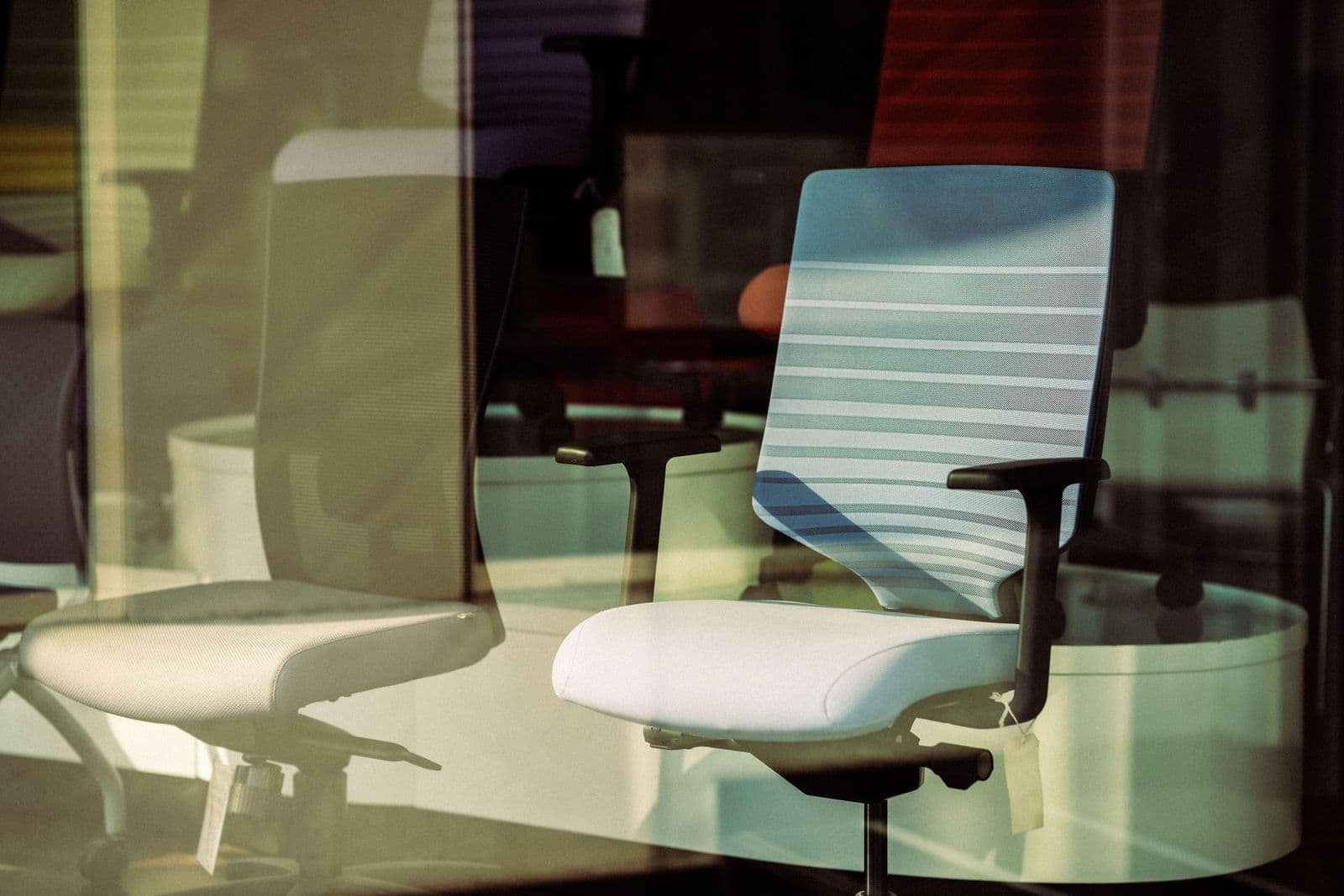
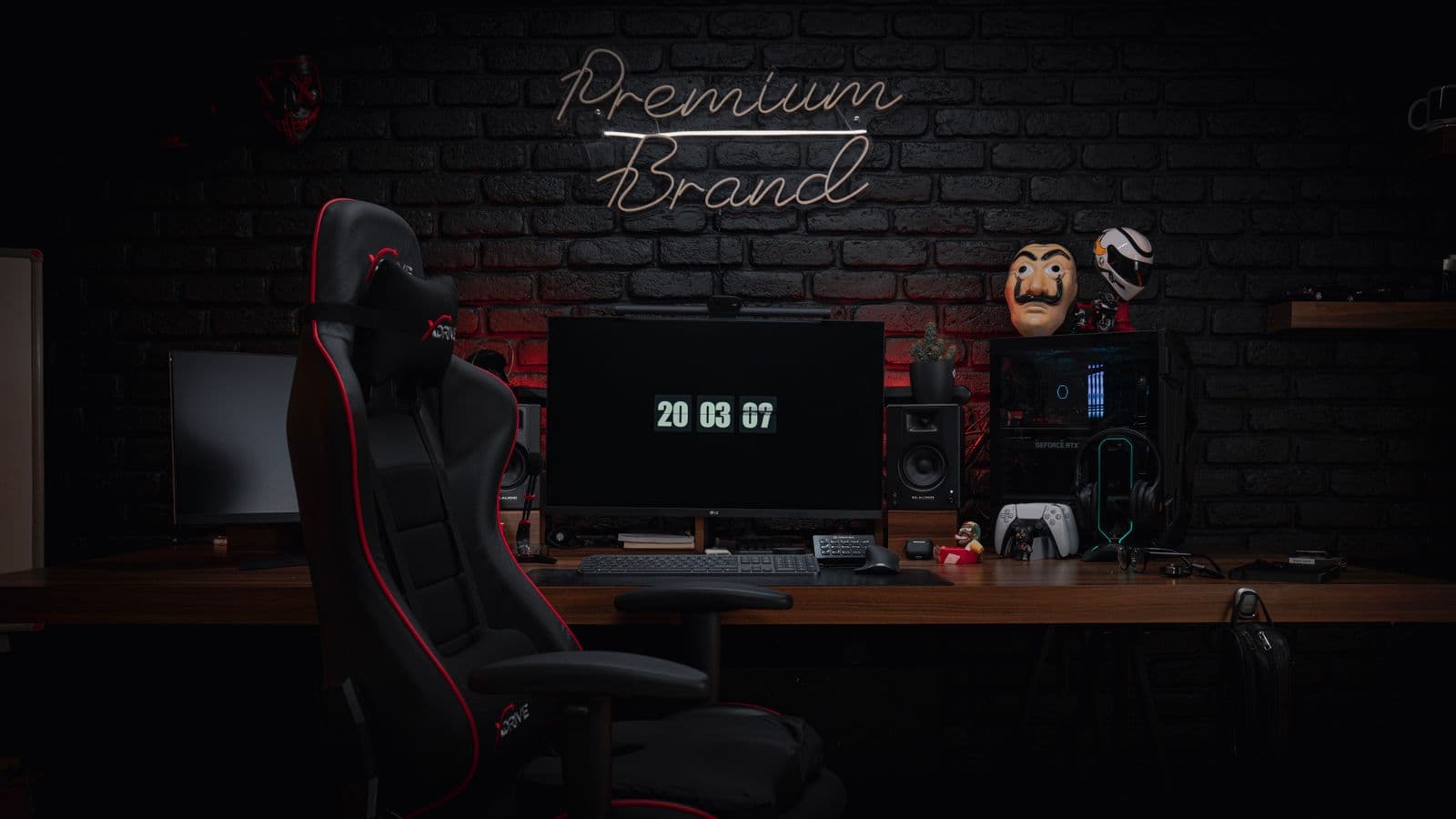
At the budget end it is a padded shell with raised side bolsters, strap-on lumbar and neck pillows, and a long recline range, like the chair in the photograph above.
At the premium end, the shell has been redesigned around office-chair mechanisms. Secretlab's TITAN Evo, the gaming chair used in the trial, lists an integrated lumbar support that adjusts for height and depth, armrests that move in four directions, a tilt lock, and a recline range of 85 to 165 degrees. It comes in three sizes keyed to user height.
A claim about "gaming chairs" that does not say which of the two it means is a claim about the paint.
The only randomized trial, and how it was run
The study is DiFrancisco-Donoghue, Zwibel and Werner, Journal of Electronic Gaming and Esports, 2025. Its own introduction notes that no earlier study had examined comfort in gaming chairs.
Thirty-three ranked League of Legends players (85% men, mean age 23) each played two continuous two-hour sessions, one in a Herman Miller Aeron and one in a Secretlab TITAN Evo, in randomized order with at least two days between sessions. Each player was fitted to the correct size of each chair under the manufacturer's guidelines and told to adjust it to their preference. Muscle stiffness was measured before and after with a MyotonPRO device at four sites on each side of the back: the upper, middle and lower trapezius and the lumbar erector spinae. Players also completed a comfort and discomfort checklist, and the team logged wins and kills.
Why esports players? The same research group had earlier surveyed 65 collegiate esports players across nine universities in BMJ Open Sport and Exercise Medicine (2019). Neck and back pain was the second most common complaint, reported by 42%, behind eye fatigue at 56%. Forty per cent did no exercise at all. They sit for a living, like desk workers, which is why the result travels beyond gaming.
What it found, and the result that runs the wrong way
The abstract reports lower muscle stiffness in the thoracic and lumbar regions, a significant reduction in left upper trapezius stiffness in the gaming chair (p = .03), a 58% preference for the gaming chair, 25% more wins and 15% more kills.
The results section and Table 2 change the picture in three ways.
Seven of the eight muscle sites showed no significant difference. The lumbar and thoracic "reductions" in the abstract are descriptive percentages, not significant results. For the erector spinae, the lower back muscle a posture buyer cares most about, the p-values were .10 on the left and .29 on the right.
The one significant result went the other way. The results text says there was increased stiffness in the left upper trapezius in the gaming chair. Table 2 agrees: mean stiffness at that site rose by 17.1 N/m in the gaming chair and fell by 24.5 N/m in the Aeron, p = .03. The abstract describes the identical comparison as a reduction in the gaming chair. Both cannot be right, and the table carries the raw numbers.
Comfort barely moved. Of the 17 checklist items in the results table, three were significant: "the chair looks nice" (7.1 against 5.3 out of 9), "I feel relaxed" (6.1 against 5.1) and "the chair is spacious" (7.3 against 6.0). "I feel comfortable" was not significant (p = .12), and neither were "I feel pain" (p = .26), "I have sore muscles" (p = .27) or "I feel stiff" (p = .97). The largest single difference in the whole checklist was appearance.
The wins and kills figures are reported as percentages with no test of significance attached, from roughly three games a session. They are a description, not a finding.
Who paid for it, and what that does and does not mean
The competing interests statement discloses funding from Secretlab Inc. under grant 589267. The gaming chair tested was Secretlab's own.
Industry funding does not make a study wrong. It does mean checking the numbers rather than the summary, which is exactly where this paper's abstract and its own table disagree. The authors list a second limitation that matters as much: one chair was visibly a gaming chair, so participants were not blind to which chair they sat in. In a study where the clearest difference was "the chair looks nice," that is not a minor caveat.
There is also a scope problem. The trial tested a premium gaming chair with an integrated, height and depth adjustable lumbar support. It says nothing about a budget chair with a strap-on pillow, which is a different mechanism. "Gaming chairs as good as office chairs" would be quoting a test of the kind of gaming chair that has been rebuilt to behave like an office chair.
The spec-sheet test: the standard does not care what a chair looks like
The American office-seating standard, ANSI/HFES 100-2007, does not mention gaming chairs, racing seats or office chairs as types. It lists functions. The chair shall have a lumbar support, a backrest that reclines, and a seat pan that adjusts for height and tilt, and the backrest shall allow at least 15 degrees of recline from vertical. It should have a seat wide enough for the clothed hip width of a 95th-percentile woman, enough seat depth that the back reaches the backrest without the seat edge touching the back of the knee, a rounded front edge, and a way to adjust backrest tension.
OSHA's computer workstation guidance adds two details a buyer can check: the lumbar support should be height adjustable, and the chair should let the backrest or seat pan move forward and back so shorter and taller users can both reach the backrest. As the guide to what "ergonomic" means on a chair listing covers, a spec sheet either answers these questions or it does not, whatever the chair is called.
| What the standard asks for | Typical budget racing-style chair | Premium gaming chair (TITAN Evo spec sheet) |
|---|---|---|
| Lumbar support, height adjustable | Strap-on pillow, slides up and down, depth set by pillow thickness | Integrated, adjusts for height and depth |
| Recline of at least 15 degrees, with tension or lock | Long recline range, check for a tension knob or tilt lock | 85 to 165 degrees, tilt lock |
| Seat wide enough for the 95th-percentile female hip | Raised side bolsters narrow the flat area | Flat seat 17.7 to 19.3 in, 20.9 to 22.8 in including the sides |
| Seat depth that fits, or adjusts | Rarely listed, check for a seat slider or a size chart | No depth slider, three sizes from 18.9 to 19.7 in |
| Rounded front edge | Check whether the bolsters rise at the front corners | Sloping edges described on the product page |
Side bolsters and the seat width you actually get
The racing shell has the clearest downside on paper. A car seat's bolsters hold the body still against cornering forces. A desk worker has none and benefits from the opposite: room to shift weight through the day.
Secretlab's specification shows what the bolsters take. The regular TITAN Evo seat is 18.5 inches wide across its flat base and 22.0 inches including the sides, so 3.5 inches of the seat's overall width is wing. The small size is 17.7 inches flat, and the XL is 19.3 inches. The company's product copy says the contoured side wings "guide you toward the middle" for a larger contact area and more even pressure. For someone who fits the flat section, that may well hold. For anyone whose hips are wider than it, it is the problem: they sit on the raised edges, not in the seat.
The practical check is to compare the flat seat width, not the overall width, with your own seated hip width. A listing that gives one width figure without saying which is not answering the question.
The strap-on lumbar pillow problem
A lumbar support has one job: hold the inward curve of the lower back so the pelvis does not roll back into a slump. How lumbar support works comes down to height first, because a support that sits above or below the curve pushes the wrong part of the spine.
A strap-on pillow can be slid to the right height, which beats a fixed bump in the wrong place. Its depth, though, is set by the foam's thickness, and a strap lets it creep as you lean back and sit up, with nothing to mark where you set it.
That is the clearest dividing line in the category. An integrated, height-adjustable lumbar meets the OSHA wording. A loose pillow relies on staying put.
What 165 degrees of recline is and is not for
Long recline ranges are a headline number on gaming chair listings. For keyboard work they are mostly irrelevant. The recline research on backrest angle lands on a working band of about 105 to 120 degrees between torso and thighs, the reclined posture OSHA lists as neutral. Past roughly 120 degrees the arms have to reach for the keyboard and the head tips forward to see the screen. A backrest that goes to 165 degrees is a lounging and napping feature.
The setting that matters is the opposite end: whether the chair holds an upright or slightly reclined posture under a tension control or lock you can set, so the backrest supports you at the angle you actually type at. The TITAN Evo spec lists a tilt lock and a tilt angle lock. A listing that gives only the recline range tells you how far back the chair goes and nothing about how it behaves at 110 degrees.
Who a gaming chair is wrong for, and who it suits
A gaming chair is the wrong choice for anyone whose hips are wider than its flat seat section, because they will sit on the bolsters all day. It is wrong for anyone shorter or taller than its size range when it has no seat depth adjustment: a seat that is too deep pushes a short user forward off the backrest, which is the problem seat depth explains. And it is wrong for anyone who would rely on a strap-on lumbar pillow for back support, because the pillow is the least reliable part of the chair.
It can suit someone who fits its size band, whose model has an integrated adjustable lumbar and a tilt lock, and who likes the firmer, more enclosed feel. The trial's own data suggest it performs about the same as an Aeron for back muscle stiffness over two hours, with one shoulder result against it, and that people like how it looks.
Whatever the shell, the adjustment order is the same. Set seat height, then seat depth or size, then lumbar height, then recline, using the steps in how to adjust an office chair.
Questions people actually ask
Are gaming chairs bad for your posture?
Not as a category. The one randomized trial found no significant difference in lower back muscle stiffness between a premium gaming chair and an Aeron over two hours. The risk sits in specific features: side bolsters that narrow the usable seat, strap-on lumbar pillows that move, and fixed seat depth. Check those on the spec sheet.
Is a gaming chair or an office chair better for back pain?
The one trial comparing them did not measure back pain outcomes, and the seating standard does not rank chair types. Judge any chair against the ANSI/HFES 100-2007 functions: a height-adjustable lumbar support, a reclining backrest with tension or a lock, a height-adjustable seat, and a seat that fits your hip width and thigh length.
Do gaming chairs have good lumbar support?
It depends on the mechanism. Some premium models have an integrated lumbar that adjusts for height and depth. Racing-style models often use a strap-on pillow, which can be moved to the right height but can creep and has a fixed depth.
Did a study prove gaming chairs are better than office chairs?
No. The 2025 trial was funded by the gaming chair's maker, found a significant difference at only one of eight muscle sites, and that difference showed higher stiffness in the gaming chair in the results table. The biggest comfort difference was that participants rated its appearance higher.
Sources
- DiFrancisco-Donoghue J, Zwibel H, Werner WG, "Sitting for Success: A Randomized Controlled Study on the Impact of Chair Design on Muscle Stiffness and Performance in Video Gamers," Journal of Electronic Gaming and Esports, 2025, 3(1), jege.2024-0018. DOI 10.1123/jege.2024-0018
- DiFrancisco-Donoghue J, Balentine J, Schmidt G, Zwibel H, "Managing the health of the eSport athlete: an integrated health management model," BMJ Open Sport and Exercise Medicine, 2019, 5(1), e000467. PMC6350739
- ANSI/HFES 100-2007, Human Factors Engineering of Computer Workstations
- OSHA eTool: Computer Workstations, Chairs
- Secretlab, TITAN Evo product page and specifications
As an Amazon Associate we earn from qualifying purchases. We earn a commission on some links, at no extra cost to you. It never changes which products we recommend or how they score. Full disclosure

Who wrote this
Editor, hardware and workstation geometry
Ellis Warner edits A Better Posture and writes the hardware side of it: desks, chairs, monitor arms and the measurements that decide whether any of them help. He reads the specification sheet, the warranty and the returns policy in full before he reads a single review, because that is where the differences between two apparently identical products actually live.
More from EllisThe standard
How this guide was built
- Manufacturer specification sheets and warranty terms, read in full rather than summarised from a listing.
- Published clinical trials and standards bodies where they exist, cited by name and linked.
- Owner reports at volume, including the one-star reviews, which is where failure modes live.
- Every price checked against the live listing on the date printed beside it.