Standing Desks for Tall People: Which Ones Actually Reach
The standard the whole category is built to stops at six foot three. Here is the arithmetic, and the four desks that go past where it stops.
By Ellis Warner, editor, hardware and workstation geometry
Published Aug 31, 2026 · reviewed Sep 4, 2026 · 11 min read
- Updated September 4, 2026
- 11 min read
In this guide
If you are over six foot three and every standing desk you look at seems to top out at almost exactly the same height, you are not imagining it and it is not a coincidence. The category is built to a standard, the standard has a number in it, and you are above the number.
The standard is the reason
ANSI/BIFMA G1-2013 recommends that a height-adjustable desk cover roughly 22 to 46.5 inches, and it is explicit about who that span is for: the 5th-percentile woman through the 95th-percentile man. UPLIFT states the same thing in its own published height-range document, describing a range as "accommodating a seated 5th percentile (5'0") to a standing 95th percentile (6'3")". Six foot three is where the design brief ends. Everything above it is a market the standard does not ask anyone to serve.
The manufacturers know. UPLIFT's own frame comparison chart says of one frame that it "works for most people 5'4" to 6'9" tall. If over 6'9" tall, consider adding casters to raise the desk 2"-5" or a keyboard tray to raise the desktop working height by up to 3"." That is a manufacturer publishing the fit limit and the workaround in the same table, which is more honesty than the category usually offers.
What you actually need
Standing elbow height runs at roughly 62 to 64 percent of stature, and the working surface should sit at or just below it. That puts the target somewhere near:
| Your height | Standing surface height | Reached by a mainstream desk? |
|---|---|---|
| 6'0" | 43.9 to 44.5 in | Yes, comfortably |
| 6'2" | 45.1 to 46.0 in | Yes |
| 6'4" | 46.4 to 47.5 in | Yes, near the top of the range |
| 6'6" | 48.5 to 49.5 in | Only at the very top of the category |
| 6'8" | 50.0 to 51.0 in | Only a handful of desks |
Read across the last row and the problem is visible. A six-foot-eight user needs about 50 inches of surface height, and the ANSI/BIFMA recommendation stops 3.5 inches lower than that. Owner reports track the arithmetic closely: one six-foot-eight owner describes a 47.2-inch desk as useless, 49.2 inches as borderline and usable only with poor posture, and 50.7 inches as barely adequate, which is almost exactly where the calculation puts the target.
Normalise the numbers before you compare them
This matters more for tall buyers than for anyone else, because at the top of the range every inch is contested. Manufacturers do not all measure the same thing.
FlexiSpot prints "Without Top" beside its ranges. UPLIFT publishes the same frame as 24.3 to 49.9 inches bare and 25.3 to 50.9 inches with a one-inch desktop. Vari and Autonomous quote complete-desk worksurface heights. So a FlexiSpot listed at 50.6 inches becomes 51.6 with a one-inch top, while an UPLIFT listed at 48.7 inches is already topped and stays 48.7.
Add your desktop thickness to any frame-only figure before you compare it to anything. Then check it against the number from the measuring guide rather than against a chart of averages.
One piece of recent news belongs here. UPLIFT replaced the V2 line, whose two-leg frame reached 50.9 inches with a top, with the V3 at 48.7. The taller option did not carry over. If you were told years ago that UPLIFT was the tall person's brand, that advice has expired.
The three that clear 51 inches, and where to get them
Three desks reach past 51 inches of worksurface once the arithmetic is normalised, and each of them is ordered direct from the manufacturer. That is worth knowing before you spend an afternoon looking for one somewhere else. The published figures:
| Desk | Published range | Topped height | Capacity | Warranty |
|---|---|---|---|---|
| FlexiSpot E7 Plus Max, four legs | 25.8 to 51.4 in, frame only | About 52.4 in | 660 lb, 880 lb on the 2.0 frame | 15 yr frame, motor, electronics |
| Autonomous Desk Pro, three-stage | 27.2 to 52.7 in, complete desk | 52.7 in as sold | Not published for this SKU | Varies by SKU |
| FlexiSpot E7 Pro, two legs | 25 to 50.6 in, frame only | About 51.6 in | 440 lb | 15 yr frame, motor, electronics |
The E7 Plus Max is the ceiling of the mainstream category. A four-leg frame at 25.8 to 51.4 inches bare lands around 52.4 inches with a one-inch top, which is the tallest surface here, and at 660 lb rated capacity nothing you put on it will be the constraint. The costs are floor space and assembly: four legs complicate a desk against a wall, it arrives as a frame with a desktop to source and drill, and building it is a two-person job. If you are six foot two, you are paying for a ceiling you will never reach.
The Autonomous three-stage desk is the tallest thing that arrives finished. Published at 27.2 to 52.7 inches as a complete desk, it needs no desktop arithmetic doing to it at all. The catch is the floor: 27.2 inches is higher than a standard fixed desk, so a shorter person cannot sit at it correctly. This is a desk for a household where nobody short shares it. Autonomous has also renamed its line repeatedly, so older reviews describe products that no longer carry those names, and warranty terms vary sharply across the range.
The E7 Pro gets most of the height on two legs. A C-frame rated to 440 lb, published at 25 to 50.6 inches without a desktop, so about 51.6 inches topped. It reaches within an inch of the four-leg frame on half the legs and a much smaller footprint, which is the right trade for most rooms. It is still a frame purchase with a top to source, and the naming across the E7, E7 Pro and E7 Plus lines is genuinely confusing when you are comparing listings.
Vari Electric Standing Desk
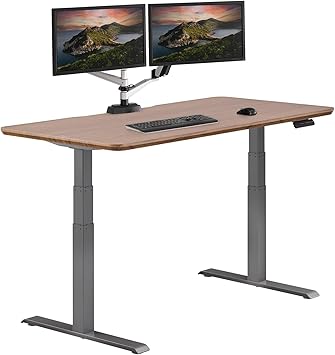
Vari Classic Electric Standing Desk 60x30
Vari publishes this desk at 25 to 50.5 inches of worksurface height, complete, with no desktop arithmetic to do. That ceiling covers a six-foot-eight user at the bottom of the target band and everyone shorter, and Vari covers its popular electric desks for the lifetime of the original owner including motors and electrical components. The 200 lb rating is the catch and the first thing to check against a heavy monitor load.
We may earn a commission on this link. It never changes the ranking.
- Height range
- 25 to 50.5 in, complete desk
- Capacity
- 200 lb
- Legs
- Three-stage, T-style
- Presets
- Four programmable
- Warranty
- Lifetime, motors and electronics named
- Size on this listing
- 60 x 30 in
What works
- Lifetime coverage that names the electrical components rather than excluding them
- Reaches 50.5 inches as sold, with no desktop thickness to add
- Four presets, which matters if two people share the desk
- Large desktop sizes suit the longer reach a taller user tends to want
What to know
- 200 lb capacity is low for a desk aimed at heavy setups
- Coverage is non-transferable and ends at resale
- Costs more per inch of desktop than the FlexiSpot frames
- 50.5 in is the ceiling, so a six-foot-nine user is still an inch or two short
Wrong for you if you run two large monitors on heavy arms plus a tower. Do the weight arithmetic first.
What does not work, and why
Converters do not solve this. A converter inherits the height of the desk under it and adds a fixed lift. BTOD, testing ten of them, found that many "raise only 13 to 14 inches above the desk, so users under 5'6" or over 6'0" can struggle, and over 6'6" usually can't reach the proper height." On a standard 29-inch desk, 14 inches of lift produces a 43-inch keyboard height, which is roughly what a six-foot person needs and four inches short of what a six-foot-four person needs. The category is structurally incapable of reaching you.
Leg extenders shift the range rather than extending it. iMovR publishes both figures for its six-inch extenders and the arithmetic is visible in its own table: a frame that ran 23.375 to 49.375 inches becomes 29.375 to 55.375. Six inches of ceiling bought with six inches of floor. For a dedicated single user that is a fine trade. For a desk anyone else sits at, it turns one fit problem into another.
Casters buy less than people expect. UPLIFT's own number is two to five inches, and casters also raise the desk's centre of gravity at exactly the extension where wobble is already worst.
The accessory that does help is a monitor arm, because at 50 inches of desk height a monitor on its factory stand sits well below eye level, and the arm is the only thing with enough vertical travel to fix it. The arm guide covers the clearance figures that matter.
Which one
You are six foot four to six foot six and want a finished desk: the Autonomous three-stage, provided nobody shorter shares it.
You are six foot six or above: the FlexiSpot E7 Plus Max topped with a one-inch surface, which is the only combination here that clears 52 inches.
You want the height without four legs in the room: the E7 Pro.
You care more about what happens in year eight: the Vari, if your load fits inside 200 lb.
Whatever you choose, buy on the normalised number rather than the advertised one, and check it against your own measurement rather than a chart. The main desk guide covers the mid-range case, and the opposite failure, a desk that will not go low enough, catches at least as many people.
Questions people actually ask
What height standing desk do I need if I am 6 foot 5?
Around 47 to 48.5 inches of working surface height, taken from the 62 to 64 percent of stature relationship that ergonomic height guidance uses. That sits at or just past the ceiling of a typical desk, which is why buyers at that height so often report that the maximum setting feels an inch or two short.
Why do almost all standing desks stop around 48 inches?
Because ANSI/BIFMA G1-2013 recommends a range of roughly 22 to 46.5 inches, sized for the 5th-percentile woman to the 95th-percentile man, which is about five feet to six foot three. Manufacturers design to the standard, so the ceiling clusters just above it. Anyone taller is outside the design brief rather than unlucky.
Do standing desk leg extenders work?
They work, but they move the whole range up rather than making it wider. iMovR's own published figures show a frame going from 23.375 to 49.375 inches becoming 29.375 to 55.375 with six-inch extenders. You gain six inches at the top and lose six at the bottom, which is fine for one tall user and a problem for a shared desk.
Can a standing desk converter work for a tall person?
Rarely. A converter adds a fixed lift to whatever desk is underneath it, and most add 13 to 20 inches to a 29-inch surface. That tops out around 42 to 49 inches of keyboard height, which is short of what someone over six foot four needs. BTOD found that over six foot six, most converters cannot reach a correct height at all.
Is the UPLIFT V2 still the tall person's desk?
No. UPLIFT replaced the V2, whose two-leg frame reached 50.9 inches with a one-inch top, with the V3 at 48.7 inches. The taller configuration did not carry across, so advice written before that change no longer applies to what UPLIFT currently sells.
Sources
- The 5th-percentile-woman to 95th-percentile-man basis of the ANSI/BIFMA G1-2013 range, and the explicit 5'0" to 6'3" framing, from UPLIFT's published height-range document.
- Frame-only versus with-desktop figures for one frame, and the casters and keyboard tray guidance, from UPLIFT's desk frame comparison chart.
- E7 Plus Max and E7 Pro ranges, capacities and warranty terms from FlexiSpot's E7 Plus Max page (flexispot.com), the E7 Pro page (flexispot.com) and FlexiSpot's warranty page.
- Three-stage Autonomous range from the Autonomous three-stage desk listing (autonomous.ai).
- Vari range, capacity and lifetime term from the Vari 60x30 listing (vari.com) and Vari's warranty policy.
- Converter lift limits and the height at which they stop working from BTOD's testing of standing desk converters.
- Leg extender ranges before and after fitting from iMovR's height extender listing (imovr.com).
As an Amazon Associate we earn from qualifying purchases. We earn a commission on some links, at no extra cost to you. It never changes which products we recommend or how they score. Full disclosure

Who wrote this
Editor, hardware and workstation geometry
Ellis Warner edits A Better Posture and writes the hardware side of it: desks, chairs, monitor arms and the measurements that decide whether any of them help. He reads the specification sheet, the warranty and the returns policy in full before he reads a single review, because that is where the differences between two apparently identical products actually live.
More from EllisThe standard
How this guide was built
- Manufacturer specification sheets and warranty terms, read in full rather than summarised from a listing.
- Published clinical trials and standards bodies where they exist, cited by name and linked.
- Owner reports at volume, including the one-star reviews, which is where failure modes live.
- Every price checked against the live listing on the date printed beside it.