Tight Hip Flexors From Sitting: What a Modified Thomas Test Actually Found
A study of 144 adults found 6.1 degrees less hip extension in heavy sitters. What that means for pelvic tilt is a separate, more contested question.
By Nadia Feld, writer, evidence and movement
Published Aug 23, 2026 · 11 min read
- Updated August 23, 2026
- 11 min read
In this guide
Tight hip flexors are one of the most confidently repeated claims in desk-posture advice, usually attached to a longer story about anterior pelvic tilt, a forward-tipped pelvis, and the low back pain it supposedly causes. Two different things are bundled into that sentence, and the evidence treats them very differently.
One part is measured and real. The other part is a popular model that two of the studies most often cited against it were published to challenge, thirty and thirty-six years ago respectively, and the field has not caught up with the correction.
What a modified Thomas test actually found
The measured part comes from a cross-sectional study of 144 adults published in Musculoskeletal Science & Practice in 2021. Researchers split participants by activity level and daily sitting time, then tested passive hip extension using a modified Thomas test, which is done by lying on the edge of a table, pulling one knee to the chest, and letting the other leg hang. How far that hanging leg extends downward is the measurement.
The group that exercised at least 150 minutes a week and sat under four hours a day had 6.1 degrees more passive hip extension than the group that exercised less and sat more than seven hours a day, a difference the authors reported at p < 0.001. The paper's own framing is careful: it is the first study to demonstrate this specific association, and it is cross-sectional, meaning it shows a difference between two groups measured once rather than a change tracked in the same people over time. It supports that sitting more and moving less correlates with a stiffer hip. It does not, on its own, prove that sitting caused the stiffness rather than the stiffness making sitting more comfortable than moving.
That distinction matters more than it sounds like it should, because almost everything built on top of this finding treats the causal direction as settled. It is not. What is reasonably solid is the correlation and its size: a six-degree gap on a test clinicians already use.
The stretch with a measured effect, and the one without
Knowing hip extension is limited is only useful if something changes it, and here the evidence gets more specific than "stretch more."
A randomised crossover trial published in 2024 took 26 healthy, active adults with confirmed hip flexor tightness on the modified Thomas test and compared two versions of the same half-kneeling hip flexor stretch across 52 hips. The first was the conventional version: forward lunge position, back knee down, weight shifted forward until a stretch is felt at the front of the hip. The second added one cue to that identical position: an active posterior pelvic tilt, tucking the tailbone under and bracing the glute on the back leg, held through the stretch.
The conventional stretch reduced resistance to hip extension by 0.06 N·m, a change the authors reported as not statistically significant (p = 0.969). The version with the added pelvic tilt reduced it by 4.85 N·m (p = 0.003, 95% CI 1.74 to 7.96), a meaningfully larger effect from what looks, to anyone watching, like the same stretch.
The mechanical explanation is straightforward. A forward lunge without a pelvic tilt lets the low back arch to take up some of the range instead of the hip joint doing the work, so the muscle never gets loaded through its full length. Bracing the glute and tucking the pelvis locks the lumbar spine out of the movement and forces the hip flexor itself to lengthen. Same position, one added cue, a result that went from a rounding error to a real number.
| Version | Cue | Measured change in hip flexor resistance |
|---|---|---|
| Conventional half-kneeling stretch | Lunge forward, feel the stretch, hold | 0.06 N·m reduction, not significant (p = 0.969) |
| Stretch with posterior pelvic tilt | Same lunge, plus tuck the tailbone and brace the back glute | 4.85 N·m reduction, significant (p = 0.003) |
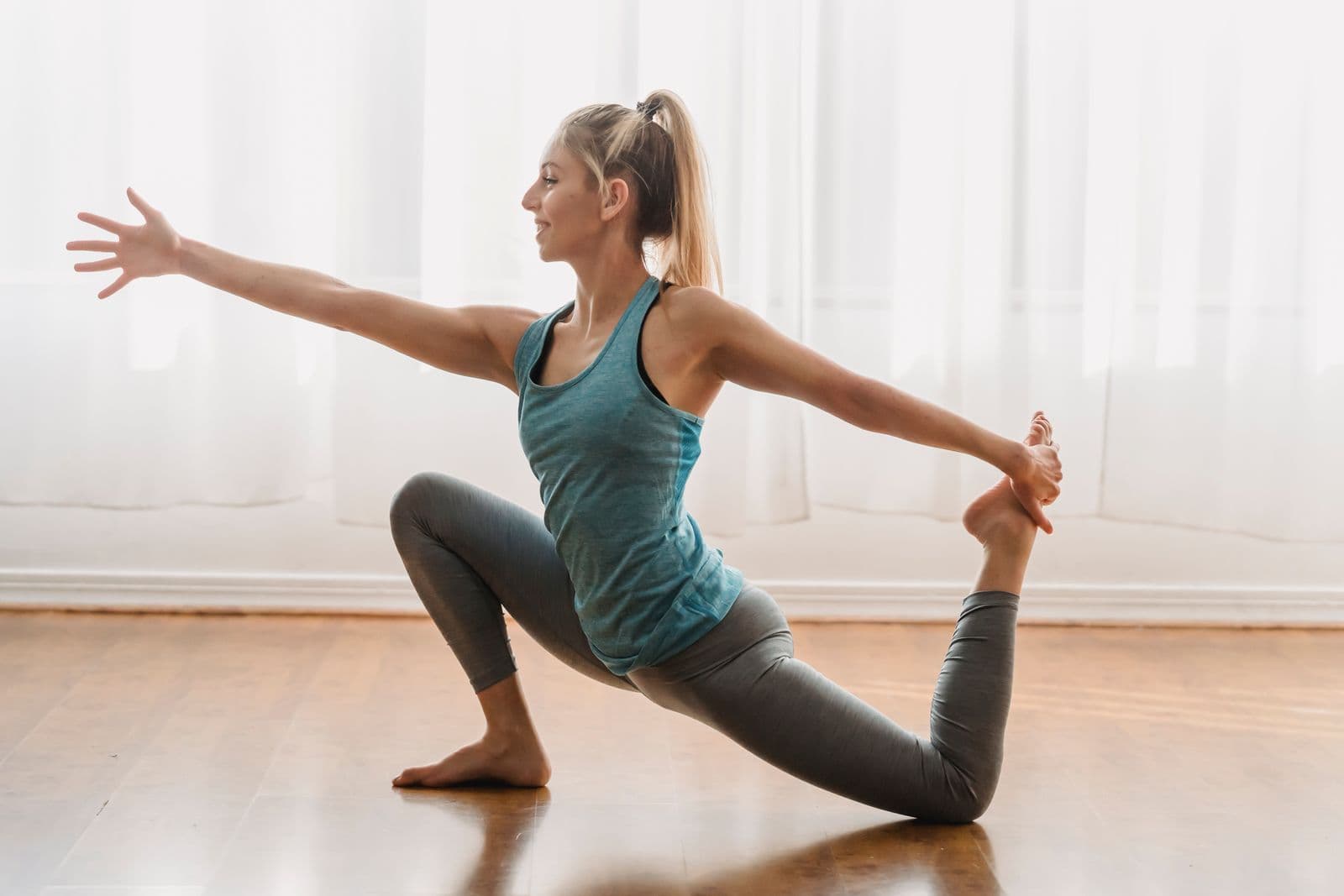
To do the version that was actually measured: kneel in a half-kneeling lunge, back knee on a cushion, front foot flat ahead of you. Before leaning forward, squeeze the glute on the back leg and tuck your tailbone under, flattening the arch in your low back. Hold that pelvic position and only then shift your weight forward until you feel the stretch at the front of the back hip. Thirty seconds, both sides. The pelvic tilt is not a minor form cue here. It is the entire difference the trial measured.
The pelvic tilt story the evidence does not support
Here is where the popular version runs ahead of what has been shown. The common explanation for why hip flexor tightness matters is a chain: tight hip flexors pull the front of the pelvis down, weak abdominals and glutes fail to counteract it, the pelvis tips anteriorly, the low back arches more than it should, and that arch causes pain.
Two studies, cited by name in the physical therapy literature specifically to push back on this model, found the opposite of what the chain predicts. Heino and colleagues in 1990 and Schache and colleagues in 2000 both examined the relationship between hip flexor length and pelvic tilt and found anterior pelvic tilt was not statically or dynamically associated with tight hip flexors. A more recent study, by Koumantakis and colleagues in 2021, looked at the piece connecting all of this back to a desk: it found no relationship between hours spent sitting and resting lumbopelvic posture.
Put those three findings next to the Thomas test study above and the picture gets more interesting, not less useful. Sitting more is associated with a stiffer hip on a clinical test. Being stiffer in that test is not shown to tip your pelvis forward. And how many hours you sit is not shown to predict how your pelvis sits at rest in the first place. The chain that gets recited from tight hip flexors to a tipped pelvis to a sore back has at least two links nobody has actually found.
None of that means the stretch above is pointless. It means the reason to do it is the specific thing that was measured, a six-degree range-of-thigh-motion deficit associated with prolonged sitting, and not the pelvic-tilt-causes-back-pain story that gets attached to it afterward. If your back hurts, that is worth investigating on its own terms rather than assuming a tight hip flexor explains it. Upper crossed syndrome is the equivalent story for the upper body, a useful shorthand for a movement pattern that was never validated as a diagnosis either.
What the study population does and does not cover
The stretch trial recruited healthy, active adults with a confirmed Thomas test deficit, not sedentary desk workers, and 26 people across two conditions is a small sample even before splitting the results by side. The direction and size of the effect are real findings. Whether the same cue produces the same 4.85 N·m change in somebody who sits nine hours a day and has not stretched in a decade has not been tested.
The sitting study has its own limit worth restating: it compared two groups at a single point in time. Somebody predisposed to tighter hips might simply be more inclined to sit rather than the sitting causing the tightness. The authors say as much. Treat the 6.1-degree figure as a real, measured difference between two groups, not as a promise about what will happen to your own hip if you stand up more this week.
Fitting this into the rest of a desk day
A stiff hip flexor is one input into a chair, not the only one. The pelvis rolling backward in a chair with the wrong seat depth changes the load on the low back regardless of hip flexor length, and it is worth ruling out before assuming the problem is upstream in the hip. Getting up on a schedule moves the hip through range several times a day, which is the more direct antidote to a joint that spends eight hours in one position, stretch or no stretch.
If the ache is higher up, five stretches for the upper back cover that separately, because the evidence for what helps a stiff thoracic spine is not the same evidence as what helps a stiff hip, and treating them as one problem tends to under-serve both. And the habit itself matters more than the specific exercise: what actually survives a real workday is a short list, and it does not include remembering to do a stretch nobody scheduled.
Questions people actually ask
Does sitting all day actually tighten your hip flexors?
A 2021 cross-sectional study of 144 adults found people who sat more than seven hours a day and exercised less had 6.1 degrees less passive hip extension than people who sat under four hours and exercised at least 150 minutes a week (p < 0.001). That is a real, measured association. It is a single-timepoint comparison between two groups, not a study that tracked the same people over time, so it shows a correlation rather than proving sitting alone causes the deficit.
Does a tight hip flexor cause anterior pelvic tilt?
The studies most often cited on this specifically, by Heino and colleagues (1990) and Schache and colleagues (2000), found anterior pelvic tilt was not statically or dynamically associated with hip flexor tightness. A separate 2021 study found no relationship between sitting hours and resting pelvic posture. The popular chain from tight hip flexors to a tipped pelvis to back pain is not supported by the research usually cited around it.
What is the right way to do a hip flexor stretch?
A 2024 randomised crossover trial found that adding an active posterior pelvic tilt, tucking the tailbone and bracing the back glute, to a standard half-kneeling lunge stretch reduced hip flexor resistance by 4.85 N·m (p = 0.003), against 0.06 N·m for the same stretch without the cue. The pelvic tilt is not optional form advice. It is the specific thing the trial found made the stretch work.
How long should I hold a hip flexor stretch?
The trial that measured a real effect used a half-kneeling position with an active posterior pelvic tilt. Thirty-second holds per side, done with that cue rather than a passive forward lean, is the version with evidence behind it.
If tight hip flexors don't cause back pain, why does stretching them still matter?
Because the measured finding, a hip extension deficit linked to prolonged sitting, is a real and separate thing from the pelvic tilt story attached to it. Restoring hip extension range is worth doing on its own terms. Assuming it will resolve back pain is a different, unproven claim, and back pain that persists is worth investigating directly rather than through the hip.
Sources
- "Prolonged sitting and physical inactivity are associated with limited hip extension: A cross-sectional study", Musculoskeletal Science & Practice, Volume 51, February 2021, 144 participants. PubMed 33188982
- "Comparison of two different stretching strategies to improve hip extension mobility in healthy and active adults: a crossover clinical trial", 2024, 26 participants, 52 hips analysed. PMC11515218
- Heino (1990) and Schache (2000), on hip extension range of motion and postural alignment, discussed with citations in E3 Rehab, "Stop Trying to Fix Anterior Pelvic Tilt", which also cites the Koumantakis et al. (2021) finding on sitting hours and lumbopelvic posture.
- Mayo Clinic: A guide to basic stretches, for general hold-time and technique guidance applied above.
As an Amazon Associate we earn from qualifying purchases. We earn a commission on some links, at no extra cost to you. It never changes which products we recommend or how they score. Full disclosure

Who wrote this
Writer, evidence and movement
Nadia Feld writes the evidence side of A Better Posture: what a trial measured, what it did not, and what that leaves you with at 3pm when your upper back aches. She is not a clinician and does not write as one. Her job is to read the paper rather than the press release, quote the actual number, and name the limitation the abstract skipped.
More from NadiaThe standard
How this guide was built
- Manufacturer specification sheets and warranty terms, read in full rather than summarised from a listing.
- Published clinical trials and standards bodies where they exist, cited by name and linked.
- Owner reports at volume, including the one-star reviews, which is where failure modes live.
- Every price checked against the live listing on the date printed beside it.