Gluteal Inhibition From Sitting: What 'Dead Butt Syndrome' Actually Measures
A 2024 study classified a sore back 85% of the time using glute and hamstring EMG alone. A 2026 trial found the exercise that raises glute activation.
By Nadia Feld, writer, evidence and movement
Published Sep 16, 2026 · 12 min read
- Updated September 16, 2026
- 12 min read
In this guide
"Gluteal amnesia" and "dead butt syndrome" are the kind of terms that sound made up for a headline, and the version of the claim that circulates online usually is: your glutes have gone to sleep from sitting and need to be woken up. What clinicians who study this mean by it is narrower and considerably more interesting than that. It is not that a muscle stops working. It is that the muscle fires later, less, or in the wrong order relative to its neighbors, and that pattern can now be measured well enough to tell a sore back from a healthy one most of the time without asking either person a single question.
The actual claim: inhibition, not sleep
The distinction is worth stating plainly: the glutes are not asleep, they are weak, or more precisely, inhibited. The mechanism usually invoked is reciprocal inhibition, the same wiring that lets you bend your elbow without fighting your triceps the whole way: when one muscle group contracts, its direct antagonist gets a neural signal to relax. Sitting keeps the hip flexors in a shortened position for hours at a stretch, and a shortened, habitually active hip flexor is proposed to send that relaxing signal to the glute on the other side of the joint more than it should. A narrative review in the Journal of Varna Medical College, covering 47 publications from PubMed, Scopus, and PEDro between 2000 and 2024, frames gluteal inhibition this way: reduced neuromuscular activation of the gluteus maximus and medius, tied to prolonged sitting, motor dysfunction, or neurological inhibition, with electromyography, clinical tests, and instrumental diagnostics as the assessment tools and motor re-education, activation exercises, and neurological facilitation as the interventions with evidence behind them. That is a review of other people's data, not a new measurement, and it is worth being honest about what a narrative review can and cannot establish: it tells you the topic has a real research base spanning two decades, not that any single dose-response number for "hours sitting" exists yet.
What does exist, and what separates this from a wellness-blog concept with no data behind it, is a specific clinical test with a specific track record.
How a stiff glute actually gets diagnosed
The test is the prone hip extension test, first described in the physical therapy literature in 1990: lie face down, keep the knee straight, lift the leg. In a normally sequenced hip extension, the gluteus maximus fires first, the hamstring follows, and the low back muscles stay quiet enough that the spine does not arch to help. The proposed problem pattern is a gluteus maximus that fires late, or a hamstring and lower back that fire early to compensate for one that will not fire enough.
For decades that firing order was mostly assessed by feel: a clinician's hand on the muscle, watching for the back to arch. A 2024 study out of the University of Regina put actual instrumentation behind it. Researchers ran 18 people with sub-acute or chronic low back pain and 32 pain-free controls through the prone hip extension test while a 3D motion capture system tracked lumbar and pelvic movement and surface electromyography measured the gluteus maximus, hamstring, and paraspinal muscles. A stepwise logistic regression built from the lumbar kinematics and the gluteus maximus and hamstring EMG amplitudes correctly classified 86.7% of the pain-free group and 83.3% of the low back pain group. In other words, the pattern the test is supposed to detect, altered lumbopelvic motion paired with a specific gluteus maximus and hamstring activation asymmetry, was distinct enough between the two groups that a statistical model built from it got the classification right roughly five times out of six.
That is a genuinely strong result for a physical exam maneuver, and it is also a single cross-sectional study of 50 people, which means it shows the pattern exists and is measurable, not that everyone with a slow-firing glute will develop back pain or that fixing the firing order resolves pain that is already present. The authors describe it as "a potentially interesting area for future research," which is measured language for a finding this specific.
The exercise with a measured effect on the pattern itself
Diagnosing a firing-order problem is only useful if something changes it, and a 2026 study gets closer to an answer than most rehab advice manages.
Published in the Journal of Back and Musculoskeletal Rehabilitation, the trial took 20 healthy men through prone hip extension with the knee bent to 90 degrees, comparing the exercise done normally against the same exercise done while applying resistance against ankle dorsiflexion with a non-elastic band, wrapped around the top of the foot and anchored so pulling the foot upward meets resistance through the whole movement. The logic is reciprocal inhibition used deliberately rather than blamed: contracting the muscle that dorsiflexes the ankle is proposed to inhibit the calf and hamstring co-contraction that normally steals the movement from the glute.
The numbers were specific. Gluteus maximus activation rose from 32% to 37.47% of maximum voluntary contraction with the band added (p = 0.02). Biceps femoris (hamstring) activation, the muscle that typically compensates when the glute under-performs, dropped from 29.26% to 19.87% MVIC (p = 0.001). The ratio between the two, gluteus-to-hamstring activation, went from 1.19 to 2.13 (p = 0.001), a more than 75% shift toward the muscle the exercise is meant to target. Multifidus activation, the deep spinal stabilizer, did not change either way (p = 0.86 and p = 0.5 on the two sides), which the authors read as the technique selectively improving glute recruitment without recruiting more low back musculature to do it, an important distinction given that low back over-recruitment is part of the compensation pattern this exercise is trying to avoid in the first place.
| Muscle | Without band resistance | With ankle-dorsiflexion band resistance | Change |
|---|---|---|---|
| Gluteus maximus | 32% MVIC | 37.47% MVIC | +5.47 points (p = 0.02) |
| Biceps femoris (hamstring) | 29.26% MVIC | 19.87% MVIC | −9.39 points (p = 0.001) |
| Gluteus-to-hamstring ratio | 1.19 | 2.13 | +79% (p = 0.001) |
To do the version that was measured: lie face down, bend the working knee to 90 degrees, and loop a light resistance band around the top of the foot, anchoring the other end so that lifting the toes toward the shin (dorsiflexing the ankle) meets tension. Hold that ankle dorsiflexion actively throughout the movement while you lift the thigh off the floor into hip extension, keeping the low back from arching. The band is doing a job here beyond adding resistance to the leg lift. It is loading a different joint on purpose. A resistance band suited to this needs specific tension and length, not whatever is already in a drawer.
The study population is 20 healthy men, which limits how far the specific percentages generalize to women, to older adults, or to anyone with an existing back injury. The direction of the finding, that adding a deliberate reciprocal-inhibition cue to prone hip extension shifts the muscle ratio the way the exercise intends, is a real and specific result. Whether it holds at the same magnitude in the population most likely to have this problem, sedentary desk workers rather than healthy young men, has not been tested.
If the goal is just raising glute activation, not fixing a ratio
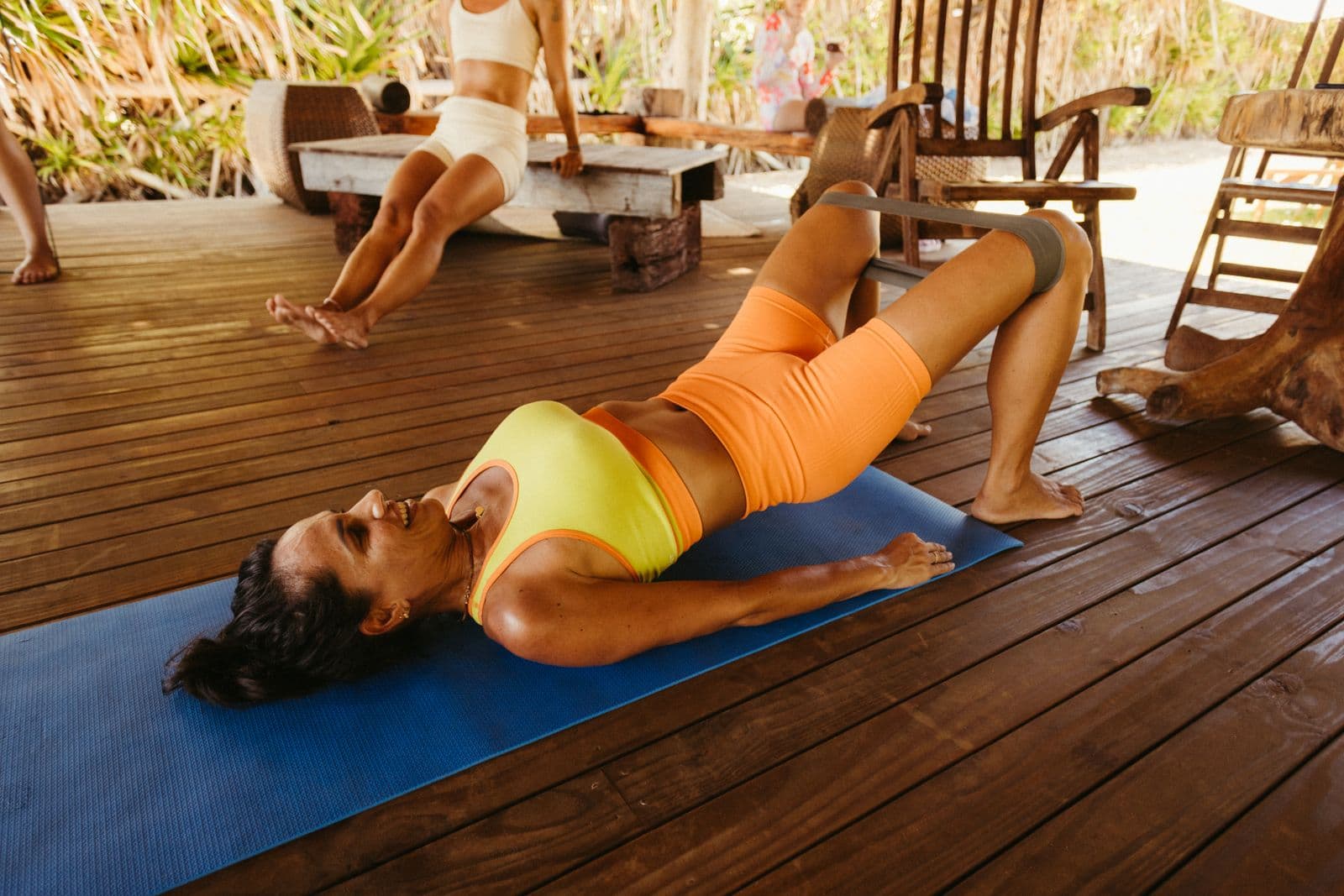
Separate from the firing-order question, a 2023 EMG study comparing two common glute exercises in 64 healthy young women found a large gap between them. The single-leg banded glute bridge, performed with a loop band above the knees and one leg extended, produced 90% MVIC (± 28%) in the gluteus medius and 75% MVIC (± 19%) in the gluteus maximus. A turn-out bent knee pulse, a smaller side-lying movement, produced 70% MVIC (± 15%) and 60% MVIC (± 20%) in the same two muscles. The difference was statistically significant (F = 16.584, p = 0.001).
| Exercise | Gluteus medius activation | Gluteus maximus activation |
|---|---|---|
| Single-leg banded glute bridge | 90% MVIC (±28%) | 75% MVIC (±19%) |
| Turn-out bent knee pulse | 70% MVIC (±15%) | 60% MVIC (±20%) |
Neither exercise in that study was tested against the prone hip extension pattern above, so this is not a single ranked list. It is two separate bodies of evidence answering two separate questions. One is about correcting a firing-order asymmetry between the glute and the hamstring. The other is about which of two common activation exercises produces more raw gluteus muscle activity. If the goal is simply more glute activation per repetition, the banded bridge has the higher number behind it. If the goal is the specific hamstring-to-glute ratio the low back pain research is built around, the reciprocal-inhibition version of prone hip extension is the one with a measured before-and-after on that exact ratio.
What none of this proves
It is worth being precise about the gap between what is measured and what gets said about it online. No study in this space has established a dose-response relationship between hours of sitting per day and the size of a gluteal firing-order deficit, the way the modified Thomas test literature has for hip flexor tightness and sitting hours. The Regina study distinguishes people who already have low back pain from people who do not; it does not show that a slow-firing glute in a currently pain-free person predicts future pain, or that correcting the pattern prevents it. And "gluteal amnesia" as a term describing a muscle that has functionally stopped working is stronger language than the actual finding supports, which is closer to a measurable shift in recruitment timing and ratio than to a muscle going offline.
Fitting this into a desk day
None of this needs a gym visit to matter. Getting up on a fixed schedule moves the hip through range and interrupts the hours-long shortened position the reciprocal-inhibition mechanism depends on, which addresses the input side of the problem rather than only the output side that activation exercises target. On the output side, core exercises aimed at sitting posture work the same lumbopelvic region from a different angle, and the two are complementary rather than redundant: a stable core and a properly firing glute are both inputs into the same prone hip extension pattern the Regina study measured. Tight hip flexors from sitting is the mechanism most directly implicated in the reciprocal-inhibition story above, and that guide covers what stretching does and does not fix about it. As with any of this, the habit that survives a real workday matters more than which specific exercise makes the strongest EMG case on paper, because an exercise with a 79% ratio shift that never gets done moves nothing.
Questions people actually ask
Is gluteal amnesia a real medical diagnosis?
It is not a formal diagnosis. It is a descriptive term for reduced or delayed gluteal muscle activation, documented across at least 47 studies reviewed in the Journal of Varna Medical College (2000–2024) using EMG, clinical tests, and motion analysis. The underlying finding, altered firing order and activation ratio, is measurable. The term itself overstates it as a muscle going fully offline, which is not what the data shows.
How is a slow-firing glute actually tested?
The prone hip extension test: lying face down, lifting a straight leg, and checking whether the gluteus maximus fires before the hamstring and lower back. A 2024 University of Regina study instrumented this test with motion capture and EMG on 50 people and correctly classified 86.7% of pain-free participants and 83.3% of low back pain participants using the resulting muscle activation and lumbar movement data.
Does sitting all day cause gluteal inhibition?
The proposed mechanism is reciprocal inhibition: a hip flexor kept in a shortened, active position by sitting is thought to inhibit the glute on the same side. This mechanism is established in general neuromuscular research, but no published study has yet measured a specific dose-response relationship between daily sitting hours and the size of a gluteal firing-order deficit.
What exercise actually improves the glute-to-hamstring firing ratio?
A 2026 trial in the Journal of Back and Musculoskeletal Rehabilitation found that adding resistance against ankle dorsiflexion (a band looped around the foot) during prone hip extension raised gluteus maximus activation from 32% to 37.47% MVIC (p = 0.02) and dropped hamstring compensation from 29.26% to 19.87% MVIC (p = 0.001), shifting the glute-to-hamstring ratio from 1.19 to 2.13, a 79% improvement, in 20 healthy men.
What exercise produces the most raw glute activation?
In a 2023 EMG study of 64 healthy young women, the single-leg banded glute bridge produced 90% MVIC (±28%) gluteus medius activation and 75% MVIC (±19%) gluteus maximus activation, significantly higher than a turn-out bent knee pulse at 70% and 60% MVIC respectively (p = 0.001). This measures a different thing than the firing-order studies above: overall muscle activation rather than the ratio between two competing muscles.
Sources
- Nikolova, "Gluteal amnesia and neuromuscular inhibition: clinical significance and evidence-based approaches to assessment and intervention," Journal of Varna Medical College, review of 47 publications (2000–2024). journals.mu-varna.bg
- Ryan N, Bruno P, "The clinical utility of the prone hip extension test in the diagnosis of motor control impairments associated with low back pain: A cross-sectional study using motion capture and electromyography," Clinical Biomechanics, 2024, 50 participants (18 low back pain, 32 controls). PubMed 39079204
- Jang TJ, Jeon IC, "Comparison of gluteus maximus, biceps femoris, and multifidus muscle activity of prone hip extension with and without reciprocal inhibition in healthy individuals," Journal of Back and Musculoskeletal Rehabilitation, 2026, 20 participants. PubMed 42105100
- EMG comparison of single-leg banded glute bridge and turn-out bent knee pulse exercises, 64 healthy young women. PMC10529521
As an Amazon Associate we earn from qualifying purchases. We earn a commission on some links, at no extra cost to you. It never changes which products we recommend or how they score. Full disclosure

Who wrote this
Writer, evidence and movement
Nadia Feld writes the evidence side of A Better Posture: what a trial measured, what it did not, and what that leaves you with at 3pm when your upper back aches. She is not a clinician and does not write as one. Her job is to read the paper rather than the press release, quote the actual number, and name the limitation the abstract skipped.
More from NadiaThe standard
How this guide was built
- Manufacturer specification sheets and warranty terms, read in full rather than summarised from a listing.
- Published clinical trials and standards bodies where they exist, cited by name and linked.
- Owner reports at volume, including the one-star reviews, which is where failure modes live.
- Every price checked against the live listing on the date printed beside it.