Tailbone Pain From Your Office Chair: What's Actually Happening, and What a Cutout Cushion Fixes
Coccydynia is five times more common in women and gets worse with sitting. Here's the mechanism, the pressure numbers, and where a cutout cushion helps.
By Ellis Warner, editor, hardware and workstation geometry
Published Sep 3, 2026 · reviewed Sep 4, 2026 · 10 min read
- Updated September 4, 2026
- 10 min read

In this guide
Tailbone pain from an office chair has a name, coccydynia, and a clinical literature that says something more specific than "get a cushion." The Cleveland Clinic and the NCBI clinical reference StatPearls both put it at five times more common in women than men, both flag sitting on a hard or narrow surface as a direct trigger, and both report that roughly 90% of cases resolve with conservative measures rather than a procedure. None of that is guesswork, and none of it requires guessing what kind of cushion actually addresses the mechanism instead of just adding padding.
What's mechanically happening when it hurts
The coccyx is the small, slightly mobile bone at the base of the spine, and StatPearls' clinical summary is specific about what puts it under load: prolonged sitting, cycling, and (counterintuitively) partly reclined postures, which shift more of your weight backward onto the tailbone rather than forward onto the sit bones. Pain characteristically sharpens when you stand up from a seated position, because the coccyx flexes slightly under seated load and that motion is what triggers pain in an already irritated joint.
Two risk factors matter more than "your chair is bad." Obesity increases pressure on the tailbone directly. But StatPearls also flags the opposite direction. Rapid weight loss is a documented risk factor, because it strips away the gluteal padding that used to sit between the coccyx and the chair, and a hard seat pan that was fine for months suddenly isn't. That single fact rules out "buy a firmer chair" as generic advice, because for a share of the people reading this, the fix runs the other way.
The pressure numbers behind "cutout cushion," not just the marketing phrase
Seating researchers have used pressure thresholds since the 1970s to judge whether a support surface is safe over time. The commonly cited figures, from Reswick's 1976 work and still referenced in current pressure-mapping literature reviewed in a PMC clinical paper on foam cut-out cushions, put a safe ceiling of roughly 30–40 mmHg at the ischial tuberosities (the sit bones, which are built to carry seated weight), around 10 mmHg at the sacrum, and effectively 0 mmHg at the coccyx itself, because the tailbone isn't supposed to be a load-bearing surface at all. That research was done on wheelchair and spinal-cord-injury seating, a population sitting far longer per day than an office worker, so the exact numbers don't transfer one-to-one. What does transfer is the principle the numbers describe: a support surface that suspends the coccyx over open space and redirects the load to the surrounding soft tissue is solving a different problem than one that just compresses everything, including the coccyx, more softly.
That's the actual distinction between a wedge-shaped or U-shaped cutout cushion and a flat foam pad. StatPearls' own treatment section names it directly: "wedge-shaped cut-out cushions allow the coccyx to hover over empty space, reducing weight-bearing," and lists U-shaped and donut cushions as the alternative shapes built around the same principle. A flat cushion, however dense the foam, puts material directly under the coccyx and can make contact pressure worse rather than better, which is the opposite of what someone with an already-irritated joint needs.
| Cushion shape | What it does | Who it's for |
|---|---|---|
| Flat foam or gel pad | Softens contact everywhere, including under the coccyx itself | General seat comfort, not active tailbone pain. Can make coccyx contact pressure worse |
| U-shaped cutout | Suspends the coccyx over an open channel, redirects load to the surrounding tissue and sit bones | Active or recent coccydynia, the shape both Cleveland Clinic and StatPearls describe |
| Donut / ring cushion | Fully encircles the coccyx with a raised ring, similar unloading principle to the U-shape | Same population as the U-shape. Some people find the full ring less stable in an office chair that already has arms and a backrest |
A cushion built to that shape

ComfiLife Gel Enhanced Seat Cushion
A U-shaped cutout over a high-density memory foam base with a cooling gel layer on top, the shape StatPearls and Cleveland Clinic both describe as the functional design for coccyx unloading rather than a flat pad marketed with the word 'ergonomic.' At 17.6 x 13.8 x 2.75 inches it's sized to sit in the middle of an existing chair seat rather than replace the whole cushion, so measure your seat pan before buying if the chair itself is narrow. The manufacturer backs it with a lifetime money-back or replacement guarantee, which matters more here than on most desk accessories because coccyx sensitivity varies enough person to person that a cushion shape that helps one person can still feel wrong to another.
We may earn a commission on this link. It never changes the ranking.
- Shape
- U-shaped posterior cutout
- Materials
- High-density memory foam base, cooling gel top layer
- Dimensions
- 17.6 x 13.8 x 2.75 in
- Base
- Non-slip rubber bottom
- Cover
- Machine-washable zippered velour
- Guarantee
- Lifetime money-back or replacement, per manufacturer
What works
- U-shape matches the cutout design both Cleveland Clinic and StatPearls describe for coccyx unloading, not a flat comfort pad
- Gel layer sits over the foam rather than the foam alone, which reduces heat buildup during a full workday without changing the cutout's unloading function
- Lifetime guarantee is a real hedge against the fact that cushion shape tolerance is individual
What to know
- At under 3 inches thick it raises your seated height slightly, which can change your desk and monitor height enough to need re-checking
- A 17.6-inch width won't fully cover a wide executive-style seat pan, so measure first
- Does nothing for the underlying causes StatPearls names, obesity or rapid recent weight loss, that a cushion shape can't address by itself
What a cushion can't do
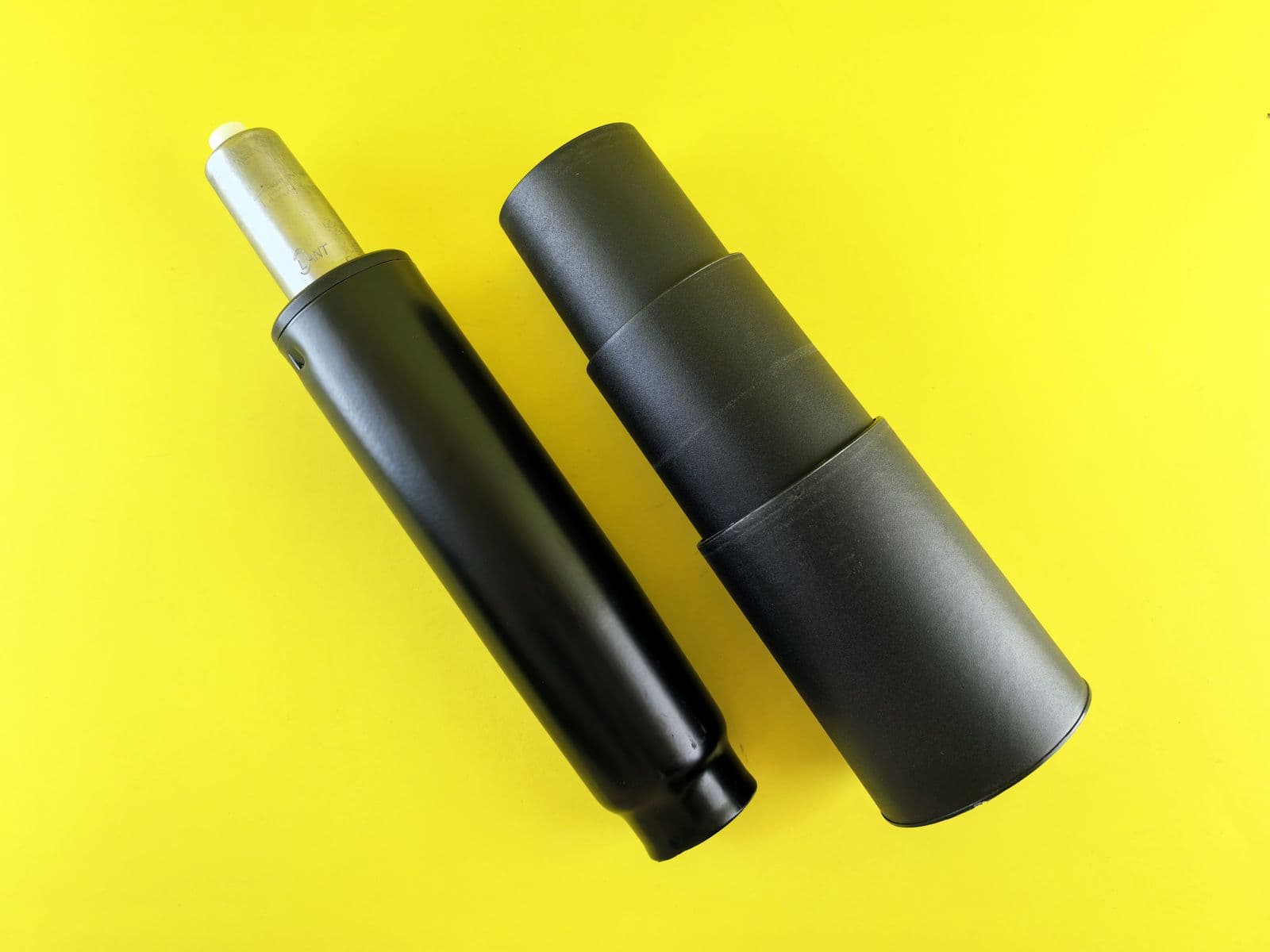
A cutout cushion changes contact pressure. It doesn't change what the chair itself is doing underneath it: a gas lift that's slowly sinking through the day changes your seat height and, with it, how much weight shifts backward onto the tailbone as your knees rise above hip height. And seat depth that runs too long for your thigh pushes you to slide forward off the backrest to relieve pressure behind the knee, which is a posture that concentrates more weight on the coccyx and sit bones, not less. A cushion sitting on top of that geometry problem is treating the symptom the chair itself is causing.
If the chair's lumbar support isn't doing its job either, the compensating slouch that follows tends to roll the pelvis backward, which is the same backward weight shift that partly reclined sitting causes according to StatPearls' pain-trigger list. A cushion built for lumbar retention rather than tailbone unloading solves a different part of the same slouch, and the two problems are worth separating rather than expecting one cushion to fix both. Working through the full adjustment sequence for the chair itself first is worth doing before adding a cushion on top of a chair that's still fundamentally mis-set for your body.
For a side-by-side of four cutout and donut cushions, including what each one does to your seat height, see the coccyx cushion comparison.
Three situations a cutout cushion doesn't cover
Rapid recent weight loss. If the padding that used to sit between your coccyx and every chair you own disappeared in the last few months, that's the risk factor StatPearls names directly, and it's worth naming to a clinician rather than solving with foam alone, because the underlying cause is different from someone whose tailbone has always been sensitive to hard seats.
Pain that started with a fall or an injury, not gradually. Traumatic coccyx injury, a fall onto the tailbone, or an injury during childbirth, is a different mechanism than cumulative sitting load, and StatPearls' conservative-treatment pathway assumes the pain is positional and load-related, not the aftermath of a specific traumatic event.
Pain that doesn't track with sitting at all. If it's present standing, walking, or lying down, or if it comes with numbness, fever, or unexplained weight loss, that's outside what a seating mechanism explains, cushion or otherwise.
Questions people actually ask
Why is tailbone pain from sitting more common in women?
The Cleveland Clinic and NCBI's StatPearls clinical reference both report coccydynia as roughly five times more common in women than men, which the literature attributes to pelvic and coccyx positioning differences that change how weight loads the tailbone in a seated position.
Does a donut cushion or a U-shaped cushion work better for tailbone pain?
StatPearls describes both as functionally similar: wedge-shaped or U-shaped cutout cushions let the coccyx hover over open space, while donut or ring cushions fully encircle it with the same unloading principle. Some people find a donut ring less stable in an office chair that already has a backrest and arms, and that's a fit preference, not a difference in mechanism.
Can rapid weight loss actually cause tailbone pain?
Yes. StatPearls names rapid weight loss as a documented risk factor for coccydynia, because it removes the gluteal padding that previously sat between the coccyx and the chair, exposing the bone to pressure a padded seat used to absorb.
How long does tailbone pain from sitting usually last?
The Cleveland Clinic reports that tailbone pain usually resolves in a few days with home remedies for milder cases, and StatPearls puts the success rate of conservative treatment overall at around 90%. Pain that persists beyond a few weeks or worsens is the point to involve a clinician.
Will a flat seat cushion help tailbone pain the same way a cutout one does?
No. A flat cushion, regardless of foam density, still places material directly under the coccyx. StatPearls specifically credits the cutout shape, not the cushioning material, with reducing coccyx weight-bearing, which is why the shape matters more than how soft the foam is.
Sources
- Cleveland Clinic, "Coccydynia (Tailbone Pain)", for prevalence by sex, sitting as a trigger, and recovery timeline.
- NCBI Bookshelf / StatPearls, "Coccyx Pain", for epidemiology, risk factors including rapid weight loss, sitting-related pain triggers, cushion shape recommendations, and the 90% conservative-treatment success rate.
- Mayo Clinic, "Tailbone pain: How can I relieve it?", for pressure-reduction cushion and forward-leaning sitting guidance.
- "Off-Loading Pressure Relief With Foam Cut Out Cushions: Experiences From Rancho Los Amigos National Rehabilitation Center," PMC, for Reswick (1976) seated pressure thresholds at the ischial tuberosities, sacrum and coccyx.
- ComfiLife, Gel Enhanced Seat Cushion product page (comfilife.com), for verified product dimensions, materials and guarantee terms.
As an Amazon Associate we earn from qualifying purchases. We earn a commission on some links, at no extra cost to you. It never changes which products we recommend or how they score. Full disclosure

Who wrote this
Editor, hardware and workstation geometry
Ellis Warner edits A Better Posture and writes the hardware side of it: desks, chairs, monitor arms and the measurements that decide whether any of them help. He reads the specification sheet, the warranty and the returns policy in full before he reads a single review, because that is where the differences between two apparently identical products actually live.
More from EllisThe standard
How this guide was built
- Manufacturer specification sheets and warranty terms, read in full rather than summarised from a listing.
- Published clinical trials and standards bodies where they exist, cited by name and linked.
- Owner reports at volume, including the one-star reviews, which is where failure modes live.
- Every price checked against the live listing on the date printed beside it.